
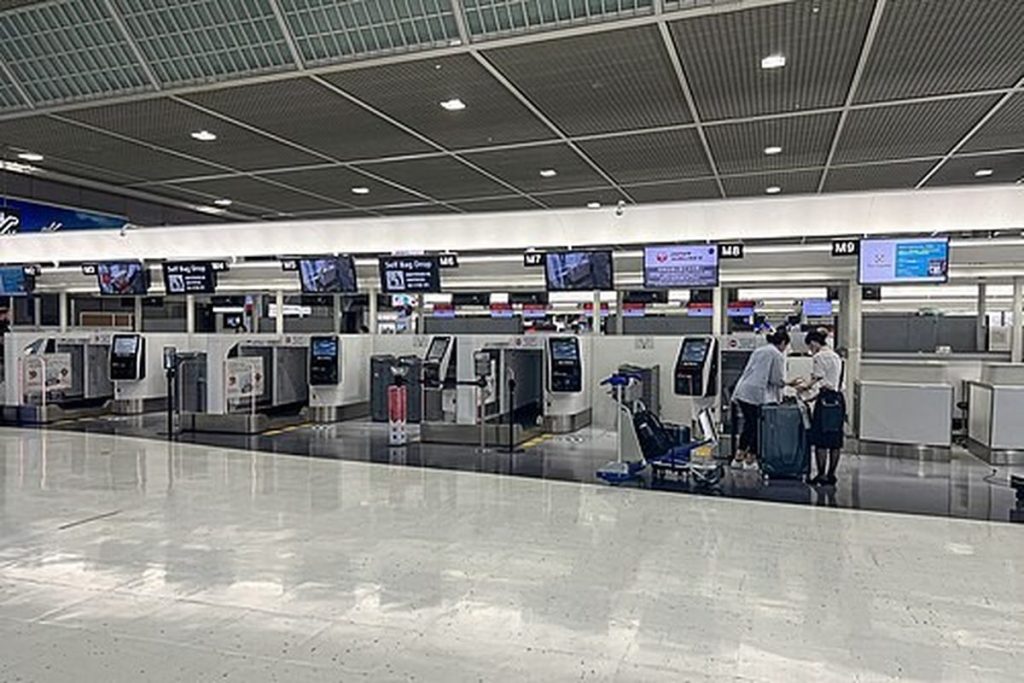
If you are leaving Japan in late 2026, the fare line that used to show about ¥1,000 for this tax now usually shows ¥3,000. The increase is already in force. This guide sticks to what the National Tax Agency (NTA), Japan Customs and the Japan Tourism Agency have published — not airline marketing pages.
For the separate shopping refund change that starts November 1, 2026, see our related guide: Japan’s new tax-free refund system.
What changed on July 1, 2026
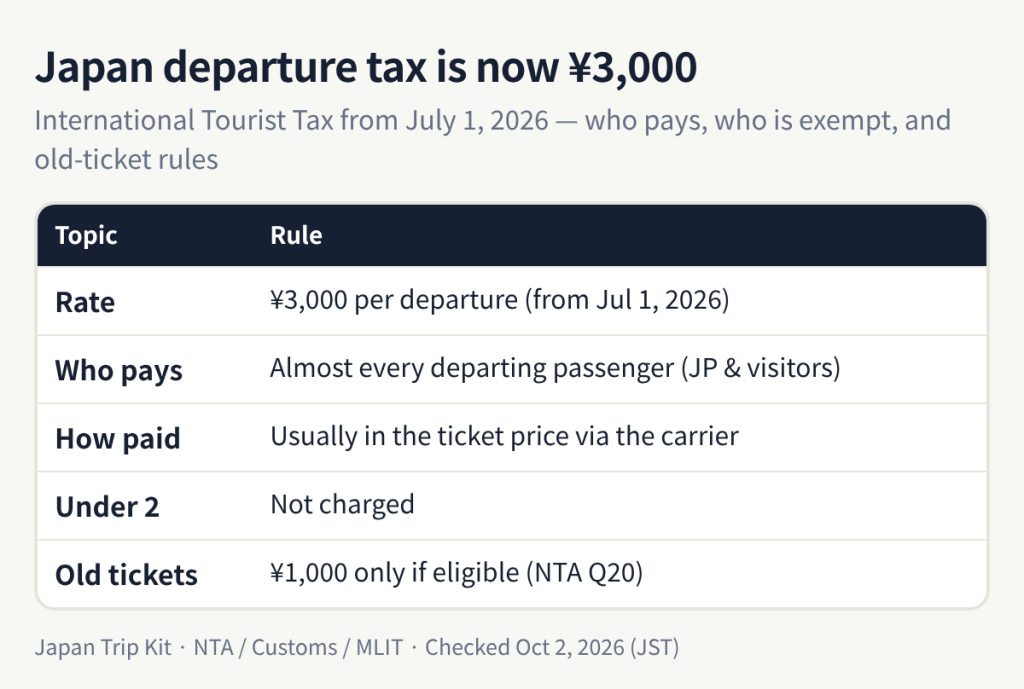
The FY2026 tax reform raised the International Tourist Tax from ¥1,000 to ¥3,000 per departure. The NTA’s English Q&A (revised April 2026) and Japan Customs both state that the new rate applies from July 1, 2026 (NTA Q&A, Q1 and Q19, Japan Customs).
For most travellers nothing changes at the airport: the airline adds the tax to the ticket price, so the increase shows up when you book, not when you leave.
The Japan Tourism Agency’s traveler leaflet summarises the same figures and notes a transitional measure for eligible tickets issued on or before June 30, 2026 (MLIT / JTA leaflet PDF).
Revenue is described as funding tourism infrastructure: crowding measures, better information for travellers, and local tourism assets. Those budget themes are policy background; they do not change what you pay at the ticket counter.
Who pays the ¥3,000 departure tax
In plain terms: if you leave Japan by international flight or ship as a passenger, you are usually liable. The formal name for the taxpayer is “international tourist,” which includes people leaving for tourism, business, study and other reasons — not only holidaymakers (NTA Q&A, Q6).
If you are a visitor flying home from Japan, assume the ¥3,000 applies to you; the exceptions below are narrow.
| Situation | Tax? | Notes |
|---|---|---|
| Adult passenger on a scheduled international flight | Usually ¥3,000 | Collected by the airline in most cases |
| Passenger on an international ferry / cruise departure | Usually ¥3,000 | Same statutory rate per departure |
| Child under 2 on the day of departure | No | Non-taxable (Q15, Customs) |
| Transit passenger leaving within 24 hours (aircraft, single ticket rules) | Often no | Strict conditions — see below |
| Crew members on duty | No | Not treated as “international tourists” |
| Private jet / non-carrier departure | Yes, unless exempt | You may need to pay Customs yourself |
Who does not pay (exemptions and non-taxable cases)
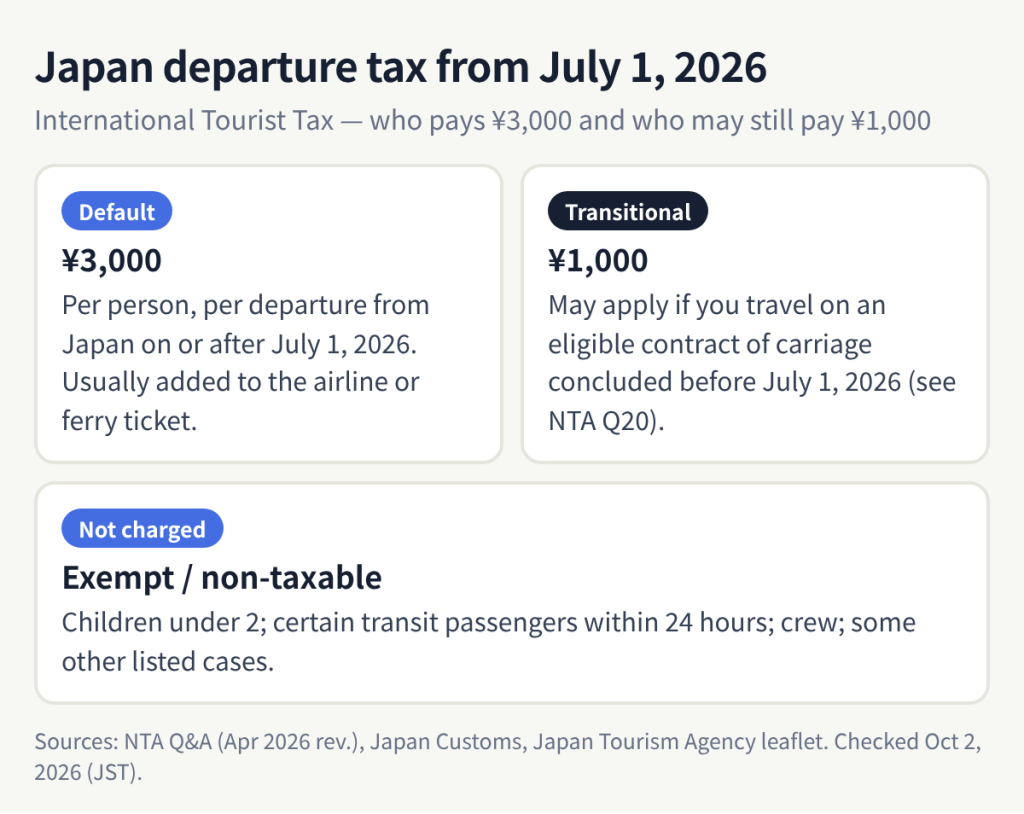
Japan Customs lists the main non-taxable and exempt groups. The common ones for travellers are (Customs overview):
Most adult tourists will not fit any of these groups; the ones worth checking are babies under two and short same-ticket transits.
- Children under 2 on the departure day.
- Certain transit passengers who enter and leave Japan by air within 24 hours under a qualifying single ticket / itinerary (see NTA Q12 — ship transit is treated differently).
- Crew members; people being deported; departures on official government ships/aircraft used only for non-commercial purposes.
- Passengers who return to Japan because of weather or similar reasons without having entered another country, in the situations the Act covers.
- Limited diplomatic / state-guest / US forces official-duty exemptions (special paperwork).
If your case is unusual (cruise landing permits, official travel, private aircraft), use the Customs or NTA contacts rather than guessing from a blog table.
Old-ticket exceptions: when ¥1,000 can still apply
For departures on or after July 1, 2026, the default rate is ¥3,000. A transitional rule can keep the old ¥1,000 rate for some contracts of carriage concluded before July 1, 2026 (NTA Q19–Q20, Customs note).
In practice the old ¥1,000 rate only matters if you bought a fixed-date ticket before July 1, 2026 and have not changed it; otherwise expect ¥3,000.
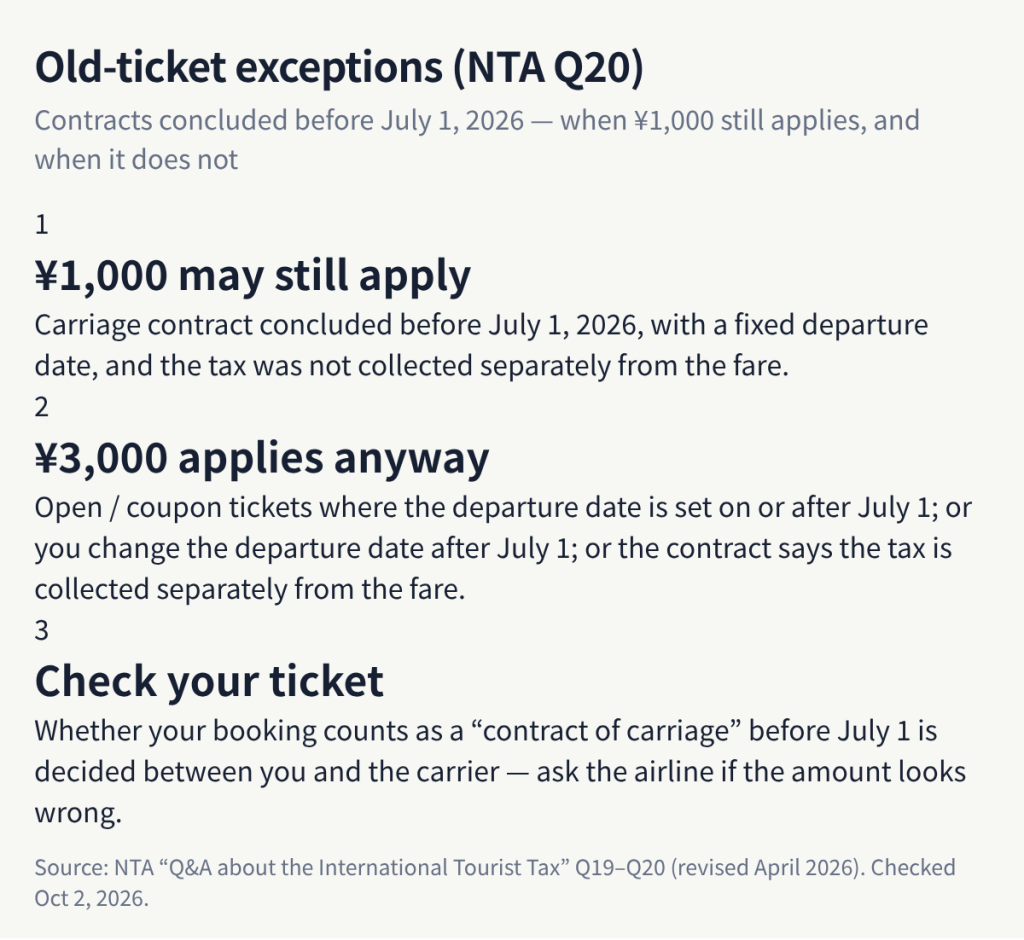
According to NTA Q20, even if the contract was concluded before the increase date, the new ¥3,000 rate still applies when any of these is true:
- Open / coupon tickets where the departure date was not fixed at booking and is decided on or after July 1, 2026.
- Date changes after July 1, 2026 — for example, a ticket first issued for July 3 that is changed on July 2 to July 4.
- Tax collected separately from the fare under the contract terms (the tax is not built into the fare the way a typical bundled ticket works).
Whether your booking counts as a “contract of carriage concluded before July 1, 2026” is decided between you and the carrier. The NTA notes that this date can differ from the date of a package tour contract with a travel agency. If the amount on your ticket looks wrong, ask the airline (or ship operator) which rate they applied and why.
How the tax is collected and shown on your ticket
For ordinary airline and ferry trips, the carrier is a special tax collector. It must collect the tax before you board and later remits it to the Japanese government (NTA Q1, Q21). Travellers usually see it as a tax or surcharge line in the fare breakdown — you do not normally pay it at a separate airport kiosk.
That is why there is no departure-tax counter at Japanese airports: on a normal airline or ferry ticket, the money has already been collected.
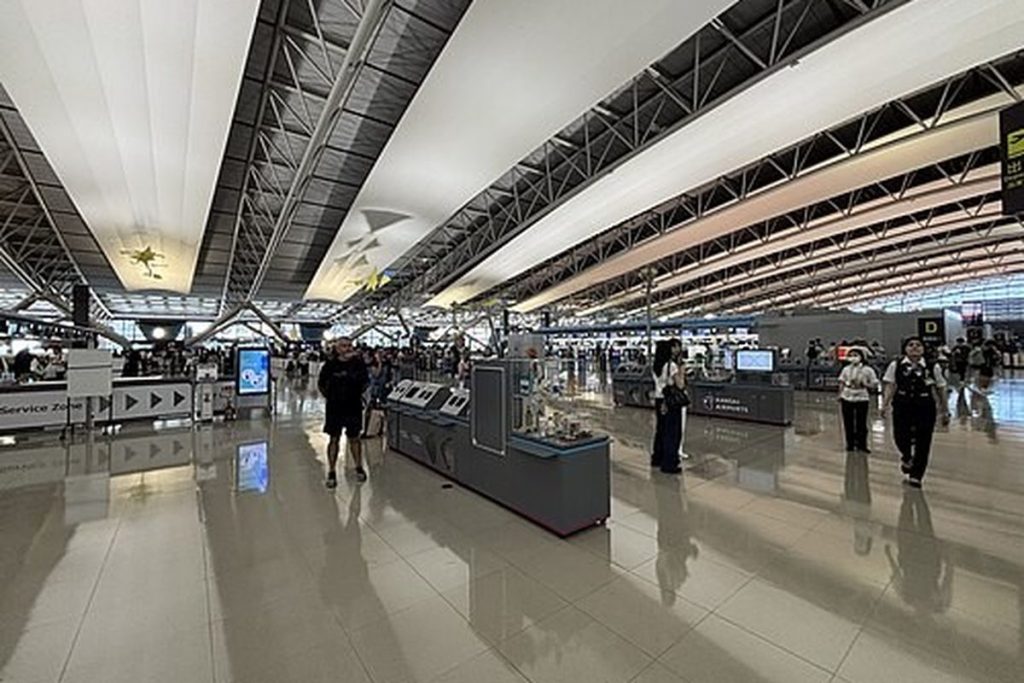
Private jets and similar cases outside international passenger transport business are different: the departing person may need to pay Customs before boarding (Q42–Q43, Customs).
Buying two seats for one person (for example, for a large instrument) does not double the tax — it is charged per departing person, not per seat (Q18).
Departure tax vs tax-free shopping refund
These are different systems. The International Tourist Tax is a departure tax on leaving Japan. The tax-free shopping change from November 1, 2026 is about consumption tax on goods you buy in Japan and take out. Paying ¥3,000 to leave does not replace the airport tax-free kiosk step for shopping refunds. See Japan tax-free refund 2026 for that process.
If you shop tax-free after November 1, 2026, plan for both: the ¥3,000 is already in your ticket, but the shopping refund needs its own stop at the airport kiosk.
Practical checklist before you fly
Two minutes with your e-ticket receipt answers almost every question about this tax.
- Read the tax line on your e-ticket or booking receipt (¥1,000 vs ¥3,000).
- If you booked before July 1, 2026 and expected ¥1,000, confirm with the airline whether your contract still qualifies.
- Travelling with an infant: check whether the child is under 2 on the departure day.
- Long transit through Japan: do not assume you are exempt — the 24-hour / single-ticket rules are narrow.
- Keep shopping tax-free receipts separate from this tax; they are handled at Customs for goods, not as part of the ticket tax.
Common mistakes travellers make
Most problems are not about the statute — they are about reading the wrong line on a receipt or mixing this tax up with something else.
A frequent mix-up is reading an airport facility charge or a fuel surcharge as the departure tax; if a line is unclear, ask the airline which one is the International Tourist Tax.
- Assuming “tourist tax” means only foreign visitors. Japanese residents leaving on the same flight usually pay the same International Tourist Tax.
- Expecting a separate booth at the airport. On normal airline tickets the carrier already collected it. You do not pay again at immigration.
- Treating every June booking as ¥1,000. Open dates, post–July 1 date changes, and separately collected tax push you to ¥3,000 under NTA Q20.
- Confusing it with the shopping tax-free refund. One is on your ticket when you leave; the other is about goods and a Customs confirmation before bag drop from November 2026.
Frequently asked questions
Is the Japan departure tax really ¥3,000 now?
Yes. From July 1, 2026 the statutory rate is ¥3,000 per departure, with a limited transitional rule for some older contracts at ¥1,000.
Do visitors and Japanese residents both pay?
Yes, in ordinary passenger cases. The tax is not limited to foreign tourists; “international tourist” in the Act covers a wide set of departing individuals.
I bought my ticket in June 2026 for a December 2026 flight. Do I pay ¥1,000 or ¥3,000?
It depends on whether your contract of carriage qualifies under the transitional rule and whether any Q20 exception applies (open date, later date change, or tax collected separately). Ask the airline if your receipt is unclear.
Is the tax refundable if my flight is cancelled?
The statutes we cite govern collection and payment by carriers. Refunds when a trip is cancelled follow the carrier’s fare rules and how they reverse the tax — ask the airline or agency that sold the ticket.
Where can I read the official English rules?
Start with the NTA English page and the April 2026 Q&A PDF (NTA International Tourist Tax, Q&A PDF). Customs publishes the Japanese overview (Customs).
Official sources
- National Tax Agency (English): Information about International Tourist Tax
- NTA: Q&A about the International Tourist Tax (April 2018, revised April 2026) PDF
- NTA (Japanese): 国際観光旅客税について
- Japan Customs: 国際観光旅客税
- Japan Tourism Agency / MLIT: traveler leaflet on the ¥3,000 rate (PDF)
Last checked against these sources on October 2, 2026 (JST). Related: Japan’s new tax-free refund system (from Nov 1, 2026).
Editorial information
- Written by
- Japan Trip Kit Editorial Team
- Published
- Updated
- Last verified
Sources
- Information about International Tourist Tax — National Tax Agency
- Q&A about the International Tourist Tax (revised April 2026) — National Tax Agency
- 国際観光旅客税について — National Tax Agency
- 国際観光旅客税 — Japan Customs
- International Tourist Tax increased to JPY 3,000 (traveler leaflet) — Japan Tourism Agency / MLIT