
Haneda Airport is directly connected to two railways: the Keikyu Line and the Tokyo Monorail. Both are ordinary commuter lines with no seat reservations, both accept Suica and PASMO, and both take you to a JR Yamanote Line station in under 15 minutes. The real difference is where they drop you: Keikyu at Shinagawa (or further, on through trains), the Monorail at Hamamatsucho. Pick the one that points at your hotel and the rest of the trip gets easier. This guide covers only the two railways; for the Limousine bus and flat-fare taxis too, see our Haneda to Tokyo guide, which compares every option by hotel area.
Every fare and time below comes from the operators’ own fare tables and access pages, checked on October 3, 2026. Times are the fastest published services; your real trip depends on the next departure and how long immigration and baggage take.
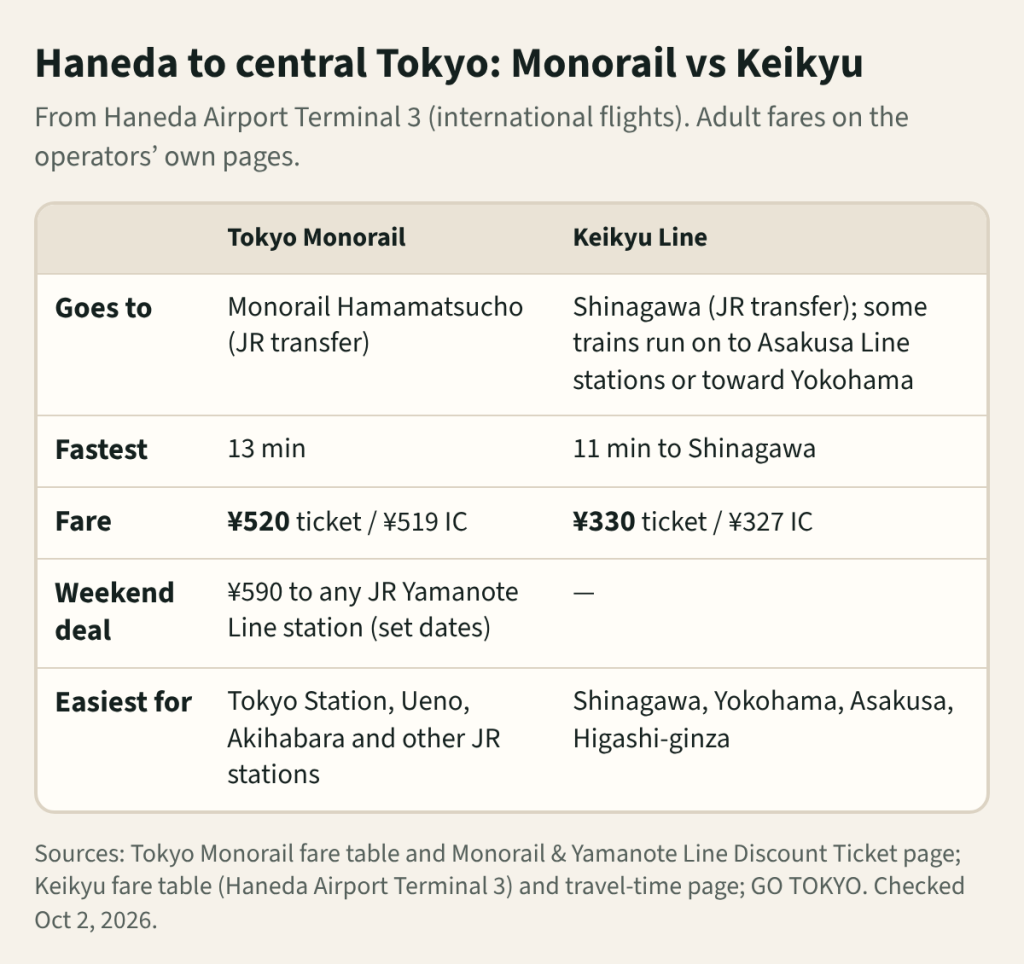
Monorail vs Keikyu at a glance
Keikyu is cheaper and a little faster to its first stop; the Monorail is the better pick for JR-side hotels, Japan Rail Pass holders and ¥590 discount days. In practice the fare gap matters less than the station you end up at, because a wrong first train usually costs you an extra change with your luggage.
| From Haneda Terminal 3 | Tokyo Monorail | Keikyu Line |
|---|---|---|
| Main transfer station | Monorail Hamamatsucho (JR Yamanote and Keihin-Tohoku lines) | Shinagawa (JR lines); some trains continue onto the Toei Asakusa Line or toward Yokohama |
| Fastest time | 13 min to Hamamatsucho | 11 min to Shinagawa |
| Adult fare | ¥520 paper ticket / ¥519 IC card | ¥330 paper ticket / ¥327 IC card |
| Through fare to a JR station | Tokyo ¥720, Ueno ¥730, Shinjuku ¥780, Ikebukuro ¥870 (paper ticket) | Keikyu fare plus the separate JR or subway fare from Shinagawa |
| Discount ticket | ¥590 to any Yamanote Line station on Saturdays, Sundays, holidays and listed dates | None for this trip on the official fare page |
| Simplest for | Tokyo Station, Ueno, Akihabara, Hamamatsucho, Shimbashi area | Shinagawa, Yokohama, Higashi-ginza, Asakusa, Oshiage (Skytree) |
Two things stand out. Keikyu is about ¥190 cheaper to its first JR transfer point, and it is the only one of the two that can carry you past central Tokyo without changing trains. The Monorail is pricier per ride, but its through tickets to JR stations are simple, and its weekend ticket can make it the cheaper way to a Yamanote Line station such as Shinjuku or Ikebukuro.
Which train for your hotel area?
Match the train to your hotel’s nearest station: Keikyu for Shinagawa, Yokohama and the Asakusa Line; the Monorail for JR stations on the east side of the loop. First-time visitors often book by neighbourhood name, so look up the actual station and its line before you fly; that one detail decides the whole route.
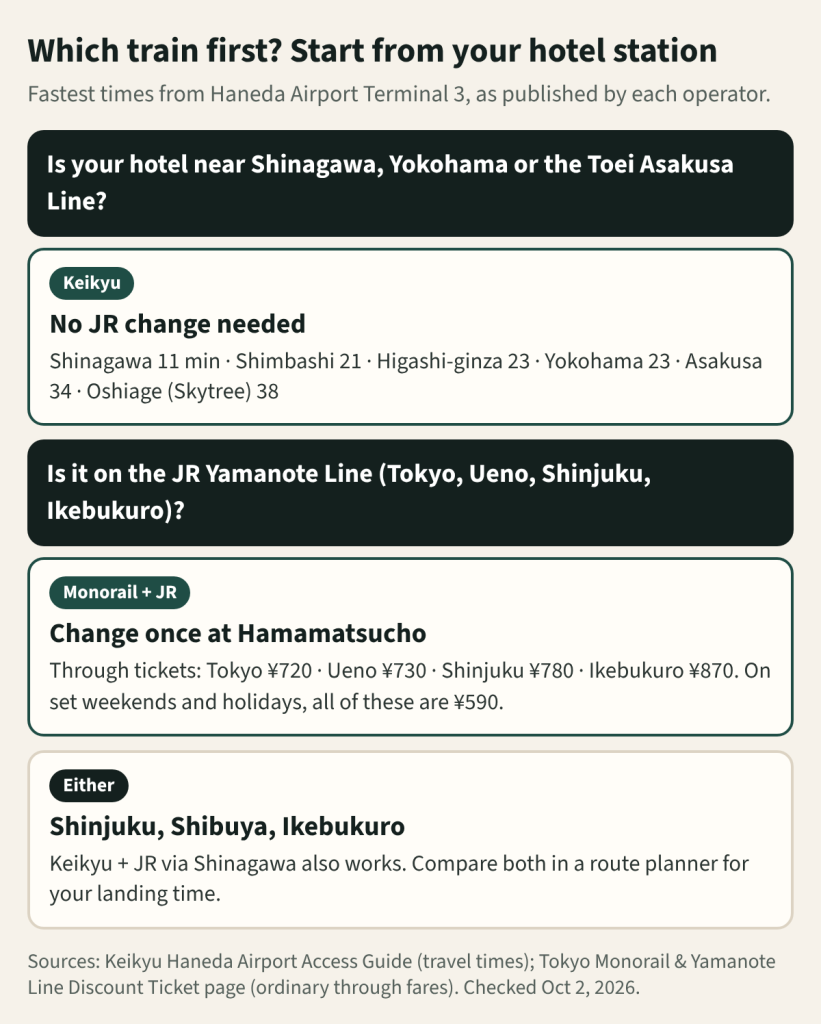
- Shinagawa, Takanawa, Yokohama: Keikyu. Shinagawa is 11 minutes and Yokohama 23 minutes from Terminal 3 on the fastest trains.
- Asakusa, Higashi-ginza, Shimbashi, Oshiage (Tokyo Skytree): Keikyu, on a train that runs through to the Toei Asakusa Line. Keikyu lists Shimbashi at 21 minutes, Higashi-ginza 23, Asakusa 34 and Oshiage 38. Not every train goes through, so check the destination on the platform display.
- Tokyo Station, Ueno, Akihabara, Kanda: Monorail, then the JR Yamanote or Keihin-Tohoku line from Hamamatsucho. A through ticket is ¥720 to Tokyo and ¥730 to Ueno.
- Shinjuku, Shibuya, Ikebukuro: either works. The Monorail through ticket is ¥780 to Shinjuku or Shibuya and ¥870 to Ikebukuro, or ¥590 on weekend discount dates. Keikyu to Shinagawa and the JR Yamanote Line from there is the other option; compare both in a route planner for your landing time.
- Late at night: trains thin out and the last one may already have gone. See our Haneda late-night transfer guide before you land.
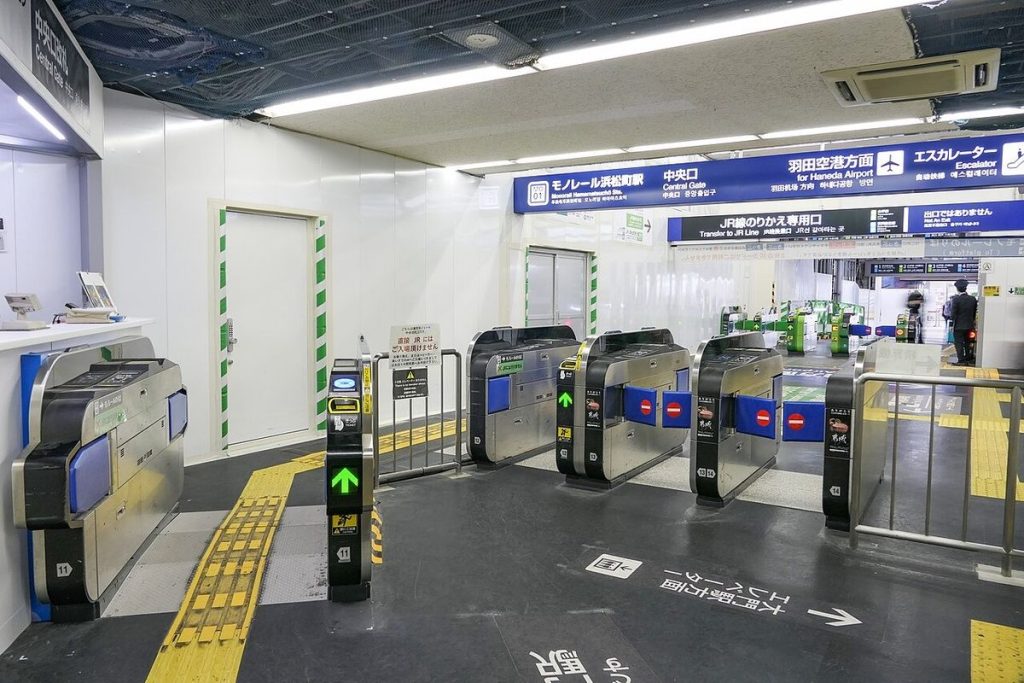
Taking the Tokyo Monorail
Take the Monorail if you are heading to a JR station such as Tokyo, Ueno or Akihabara, or if you hold a Japan Rail Pass. Its advantage is simplicity rather than price: one ride to Hamamatsucho, one change, and a ticket you can buy straight through to your JR station.
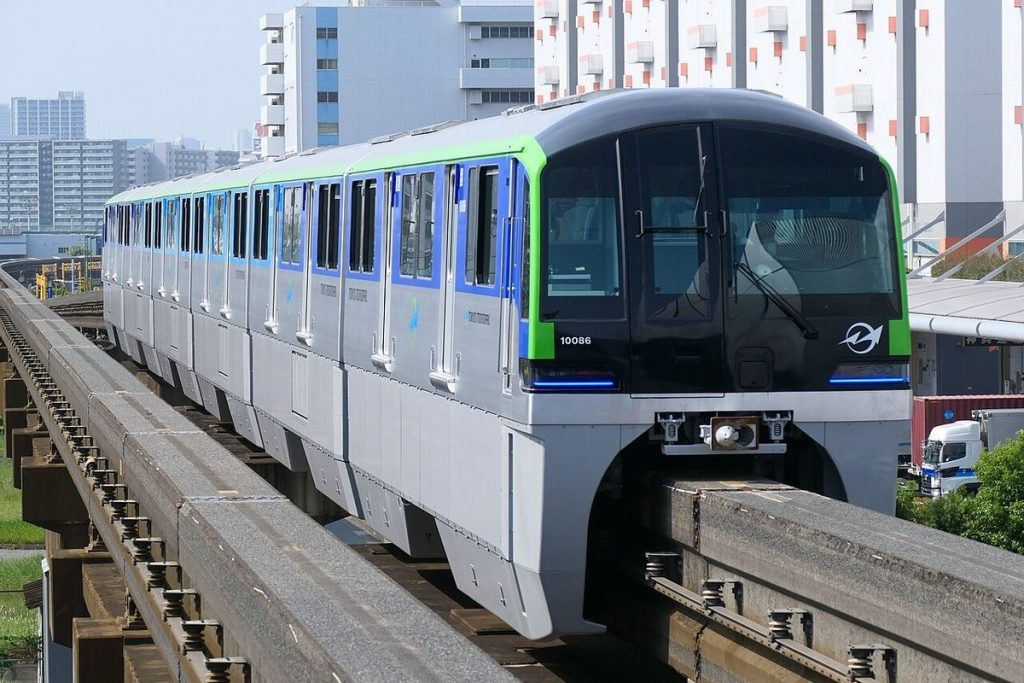
Tokyo Monorail says its trains run on average every five minutes from Haneda Airport to Hamamatsucho (Tokyo Monorail, quick transfers). The fastest service from Terminal 3 takes 13 minutes; slower trains stop at every station on the way. The IC card fare of ¥519 applies from Terminal 3 and from Terminals 1 and 2 alike.
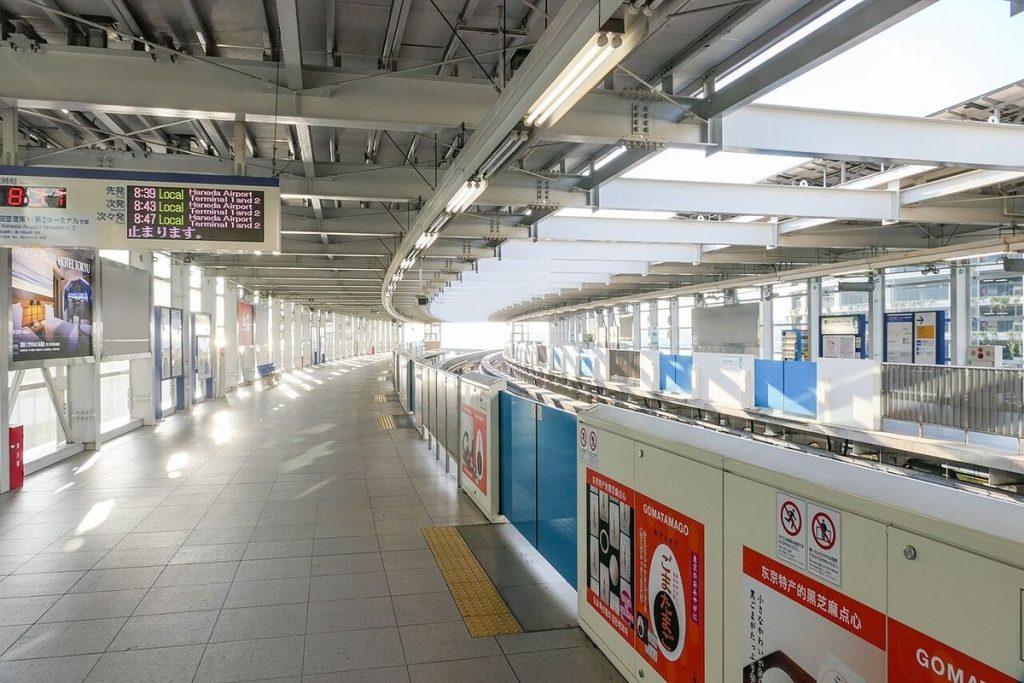
The ¥590 Monorail & Yamanote Line Discount Ticket
If you land on a Saturday, Sunday or national holiday, this is the best-value way to a Yamanote Line station. It costs ¥590 for adults and ¥290 for children aged 6 to 11, and covers one trip from any Haneda station through Monorail Hamamatsucho to any JR Yamanote Line station (Tokyo Monorail). That compares with ordinary through fares of ¥680 to ¥870. For Shinjuku, Shibuya or Ikebukuro, that flips the usual answer: on valid dates the Monorail becomes both the simpler and the cheaper route.
- Sold only at the ticket machines in the three Haneda stations, and valid only on the day you buy it.
- On sale on Saturdays, Sundays and holidays from March 14, 2026 to March 31, 2027, plus listed periods that include weekdays, such as October 1 to 7, October 31 to November 3, and December 26, 2026 to January 3, 2027. The full list is on the official page.
- At Hamamatsucho you pass two sets of gates. Take the ticket back each time; the last gate on the Yamanote Line collects it.
Taking the Keikyu Line
Take Keikyu if you are staying around Shinagawa, Yokohama or the Asakusa Line, or simply want the cheapest ride. Its strength is also the main trap for first-timers: trains from the same platform split toward Tokyo or Yokohama, so the destination display matters more than the platform number.
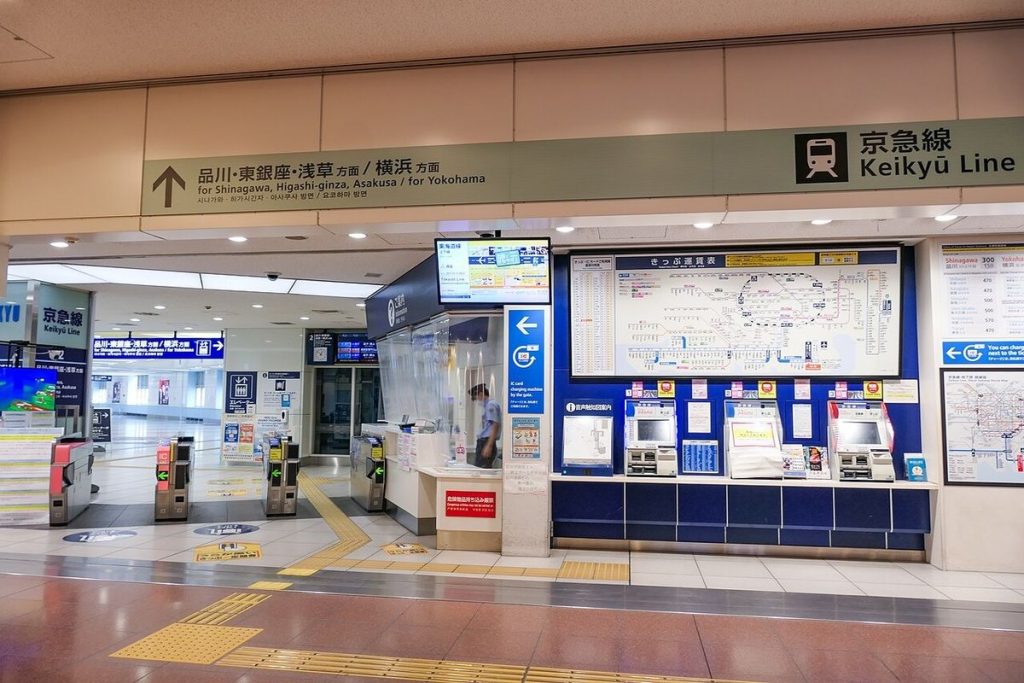
From Terminal 3, Keikyu’s fastest trains reach Shinagawa in 11 minutes, and from Terminals 1 and 2 in 14 minutes (Keikyu travel times). The adult fare from Terminal 3 to Shinagawa is ¥330 by paper ticket or ¥327 by IC card, and ¥370 or ¥363 to Yokohama (Keikyu fare table, PDF).
- Buying a paper ticket into Tokyo: Keikyu tells visitors to press 都営線 (Toei Line) if they are staying on the train onto the subway, or JR線品川乗換 (Transfer to JR Lines) if they are changing at Shinagawa.
- Check the destination, not just the platform: trains from the same platform split toward central Tokyo and the Asakusa Line, or toward Yokohama. Keikyu’s own advice is to check the departure time and destination display before boarding (Keikyu train line map).
- Shinagawa is a big station: if you change to JR there, follow the signs for the JR transfer gate rather than heading for the station exits.
IC card or paper ticket?
Either works on both lines. With Suica, PASMO or another transit IC card, you tap in and out and pay the IC fare, calculated to the yen when you board and exit with the same card. Paper tickets are rounded up to the nearest ¥10. The difference is small; the bigger win is not queuing at a ticket machine with your bags. If you have not sorted out a card yet, read which IC card to use as a tourist.
The exception is the Monorail’s ¥590 weekend ticket. It is a paper ticket from the machine, so buy it instead of tapping your IC card if it is valid on your arrival day.
With heavy luggage, kids or a late arrival
With big suitcases, small children or a late landing, fewer changes beat a faster train. Shinagawa and Hamamatsucho are busy at commuter peaks, and every change means moving your bags again. If your hotel sits next to a limousine bus stop, the bus may be the calmer choice even though it is slower: GO TOKYO lists about 55 minutes from Haneda to Tokyo Station or Shinjuku Station by Airport Limousine (GO TOKYO). For arrivals near midnight, the late-night guide compares train, bus, taxi and private car.
Before you leave the arrivals hall
Decide on your train before you reach the station gates. Both stations are a short walk from arrivals, so the decision, not the walk, is what slows most people down.
- Write down your hotel’s nearest station and which line it is on.
- Asakusa Line station, Shinagawa or Yokohama: head for Keikyu. JR station near Tokyo or Ueno: head for the Monorail.
- Landing on a weekend or holiday and going to a Yamanote Line station? Check the ¥590 Monorail ticket dates.
- Load an IC card, or know which button to press at the ticket machine.
- Holding an activated Japan Rail Pass? Use it on the Monorail; Keikyu needs a separate fare.
- On the Keikyu platform, read the destination on the display before you board.
- After about 23:00, check the last trains and your backup before you leave arrivals.
Frequently asked questions
Is the Keikyu Line or the Tokyo Monorail cheaper from Haneda?
Keikyu, to its first transfer point: ¥330 to Shinagawa versus ¥520 to Hamamatsucho from Terminal 3 by paper ticket (¥327 and ¥519 by IC card). On weekend discount dates, the Monorail’s ¥590 ticket to any Yamanote Line station can beat Keikyu plus a separate JR fare.
Which is faster to central Tokyo?
They are close. Keikyu’s fastest train reaches Shinagawa in 11 minutes from Terminal 3; the Monorail’s fastest reaches Hamamatsucho in 13 minutes. The change of trains and the wait for the next departure matter more than the two-minute gap.
Which train goes to Shinjuku?
Neither goes there directly. Change to the JR Yamanote Line at Shinagawa (Keikyu) or Hamamatsucho (Monorail). The Monorail through ticket to Shinjuku is ¥780, or ¥590 on weekend discount dates.
Can I go from Haneda to Asakusa without changing trains?
Yes, on Keikyu trains that run through to the Toei Asakusa Line. Keikyu lists the fastest trip from Terminal 3 to Asakusa at 34 minutes. Check that your train’s destination is on the Asakusa Line before you board.
Can I use Suica or PASMO on both lines?
Yes. Both lines accept transit IC cards, and IC fares are calculated to the yen when you enter and exit with the same card.
Does the Japan Rail Pass cover the Monorail or Keikyu?
The Tokyo Monorail, yes: the official Japan Rail Pass site lists it among the services the pass covers (Japan Rail Pass, scope of validity). Keikyu is a private railway and needs a separate fare. With a pass, the Monorail to Hamamatsucho plus JR onward costs nothing extra, which makes it the obvious choice.
Official sources
- Tokyo Monorail: fare table from Haneda Airport Terminal 3 Station (Japanese, PDF) and English fare table
- Tokyo Monorail: Monorail and Yamanote Line Discount Ticket
- Tokyo Monorail: quick transfers from Haneda Airport
- Keikyu: fare table from Haneda Airport Terminal 3 (Japanese, PDF)
- Keikyu Haneda Airport Access Guide: fare and time search and train line map
- Haneda Airport: train and monorail access
- GO TOKYO: Haneda Airport access
- Japan Rail Pass: scope of validity (Tokyo Monorail coverage)
Last checked against these sources on October 3, 2026 (JST). Fares and timetables change; confirm on the operator’s page before you travel.
Editorial information
- Written by
- Japan Trip Kit Editorial Team
- Published
- Updated
- Last verified
Sources
- Fare table from Haneda Airport Terminal 3 Station — Tokyo Monorail
- Monorail and Yamanote Line Discount Ticket — Tokyo Monorail
- Quick transfers — Tokyo Monorail
- Fare table from Haneda Airport Terminal 3 — Keikyu
- Fare and time search — Keikyu
- Train and monorail access — Japan Airport Terminal
- Haneda Airport access — GO TOKYO