
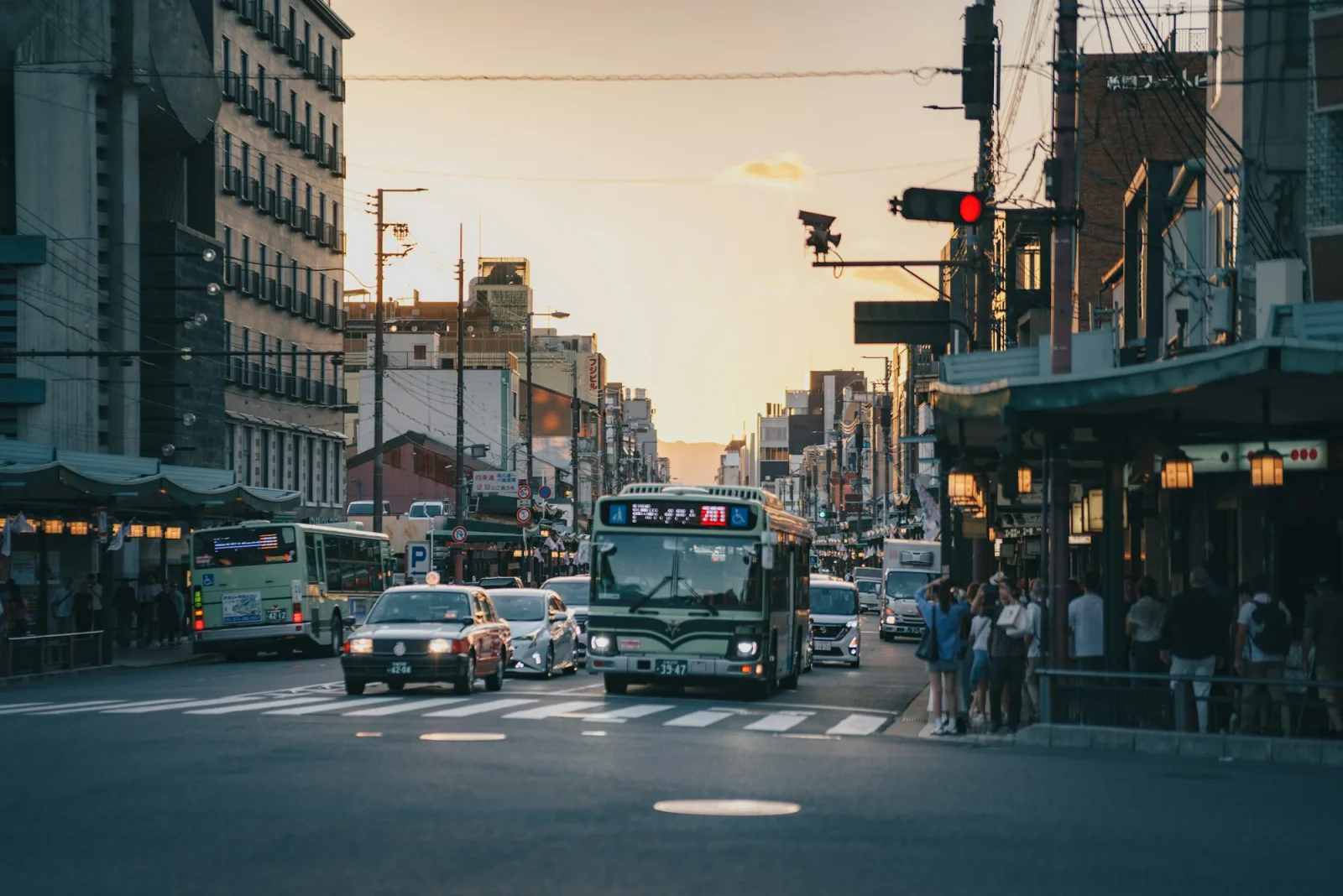
Photo: Daniel Seßler / Unsplash
Kyoto’s main sights are spread around the edges of the city and its subway has only two lines, so first-time visitors end up on buses by default, which is where the crowds and delays start. The sections below price the city bus, subway, trains, taxis and bikes in yen and minutes, match each of five sights to a route, and check which day passes still exist.
Bus, subway, train, taxi or bike: how they compare
For most sights, the fastest and least crowded option is a train or the subway to the nearest station, then a short walk or one bus. The city’s own tourism site says the key is to use both trains and buses, and it shows travel times from Kyoto Station: about 10 minutes to Fushimi Inari, 25 to Arashiyama, 35 to Higashiyama (Kiyomizu-dera) and 40 to Kinkaku-ji.
| Option | Fare | Best for | Watch out for |
|---|---|---|---|
| Kyoto City Bus | ¥230 adult, ¥120 child, flat-fare zone; outside it the fare varies | Short hops from a subway or train station | Crowded in cherry blossom and autumn foliage seasons and at 7:00–9:00 and 18:00–19:00 |
| Sightseeing Limited Express EX100/EX101 | ¥500 adult, ¥250 child | Kyoto Station to Kiyomizu-dera, Gion and Ginkaku-ji | Runs on weekends and holidays; check the day’s timetable |
| Kyoto City Subway | ¥220–¥360 by distance | North–south (Karasuma Line) and east–west (Tozai Line) trips | Only two lines; does not reach Fushimi Inari, Kiyomizu-dera, Arashiyama or Kinkaku-ji itself |
| JR (Nara Line, Sagano Line) | Check JR West’s fare search | Fushimi Inari and Arashiyama from Kyoto Station | Sagano Line platform is a long walk; trains are crowded |
| Keihan, Hankyu, Randen | Separate fares; check each operator | Keihan to Fushimi Inari, Kiyomizu-Gojo and Gion-Shijo; Hankyu and Randen to Arashiyama | Each railway charges its own fare |
| Taxi | Initial fare, then distance and waiting time | Groups of up to four; early or late trips | Long queues at stations in peak seasons; some drivers speak little English |
| Bicycle | Rental shops listed on the city’s cycling site | Flat central Kyoto, Kamo River, Arashiyama | Illegally parked bikes are removed (¥3,500 to retrieve) |
The best way to reach each main sight
Match the sight to the line, not the other way round. These are the routes the Kyoto City Tourism Association recommends from Kyoto Station.
- Fushimi Inari: take a JR Nara Line local from platform 8, 9 or 10 to Inari Station (about 5 minutes per JR West, which warns that express trains skip Inari). The shrine is right outside the gate. From Gion-Shijo, Keihan runs direct to Fushimi Inari Station in about 22 minutes (limited express trains skip it), then about 5 minutes on foot. Avoid City Bus South No. 5, which the tourism site says can vary by more than 24 minutes.
- Kiyomizu-dera: the City Bus to Gojozaka often tops route-search results but is frequently congested, says the tourism site. On weekends and holidays use the EX100 or EX101 (¥500, about 10 minutes from Kyoto Station). Other days, ride the Karasuma Line one stop to Kujo and take City Bus 202 or 207, which it calls relatively uncrowded. Keihan to Kiyomizu-Gojo and a walk up is another option.
- Gion: ride the Karasuma Line to Karasuma Oike, change to the Tozai Line and get off at Higashiyama. The official guide gives about 15 minutes from Kyoto Station. From Shijo-Kawaramachi, walk about 13 minutes rather than take the Shijo-dori bus.
- Arashiyama: the JR Sagano Line rapid reaches Saga-Arashiyama in about 11 minutes, then about 8 minutes on foot to Togetsukyo Bridge. The line is fast but crowded, its platform at Kyoto Station is far away, and the tourism site says to board from the back. For a calmer ride, take the subway to Uzumasa Tenjingawa and change to the Randen tram to Arashiyama Station.
- Kinkaku-ji: ride the Karasuma Line to Kitaoji, then take bus 204 or 205 from the Blue Bus Stop at the adjacent bus terminal; about 11 minutes to Kinkakuji-michi plus a 5-minute walk. Avoid the No. 205 that leaves Kyoto Station itself, which stops often and is slow.
Buses and crowds: when to avoid them
Buses are most crowded in cherry blossom season, in autumn foliage season and during commuting hours, so avoid them for long rides at those times. The tourism site gives the commuting peaks as 7:00–9:00 and 18:00–19:00. Since June 1, 2024, the city has added frequency on loop and main-line buses and introduced limited-express services to ease crowding. That helps, but it does not remove the crush on popular routes.
- Skip Kyoto Station as your starting point. The tourism site suggests getting off JR trains at Nijo, Enmachi, Tofukuji or Yamashina instead, then continuing from there.
- Bring less luggage. The tourism site recommends baggage storage or delivery before boarding; see our luggage forwarding guide.
- Check the bus before you board. The EX100 and EX101 are boarded at the front and paid on boarding; most other routes are paid on exit, and a bus in the wrong direction is a detour.
Does a day pass pay? What exists now
The old bus-only 1-Day Pass no longer appears to be sold, and the one that remains, the Subway & Bus 1-Day Pass, pays only on a heavy bus-and-subway day. The Transportation Bureau’s ticket page now lists just three items: the Subway & Bus 1-Day Pass, a Subway 1-Day Pass and IC cards. The bureau’s page for the old Bus 1-Day Pass now returns “not found,” and kyoto.travel’s list of Kyoto passes does not include it.
- Subway & Bus 1-Day Pass: ¥1,100 adult, ¥550 child. Covers all city subway lines and city bus routes, and parts of Kyoto Bus, Keihan Bus and West Japan JR Bus (some routes excluded). It is valid only on the day you first use it, not for 24 hours, and not on the SKY HOP BUS.
- Subway 1-Day Pass: ¥800 adult, ¥400 child. All subway lines only.
- Arashiyama side: kyoto.travel lists a Subway and Randen 1-Day Pass (¥1,300, sold April 1, 2026 to March 31, 2027) and a digital Kyoto/Arashiyama 1-Day Pass for Hankyu, Randen and Kyoto Bus (¥1,400, October 1 to December 20, 2026).
- Keihan side: a digital Keihan Kyoto 1-Day Pass (¥1,100) covers the Main Line between Iwashimizu-hachimangu and Demachiyanagi. The foreign-visitor Kyoto Sightseeing Pass is ¥1,100 for one day or ¥1,300 for 24 hours.
At ¥230 per flat-zone bus ride, the ¥1,100 pass breaks even at the fifth ride (5 × ¥230 = ¥1,150). Two EX100 rides (¥1,000) plus one regular bus (¥230) come to ¥1,230. A day that uses JR to Fushimi Inari or Arashiyama gets no help from the city pass, since JR is not covered. The Keihan pass only pays if your Keihan rides add up to more than ¥1,100 on the operator’s fare table.
IC cards: what works and what doesn’t
An IC card (Suica, PASMO, ICOCA, PiTaPa and similar) works on both the city bus and the subway, so it is the default payment method. The Transportation Bureau’s list also includes Kitaca, manaca, TOICA, nimoca and SUGOCA. For choosing a card, see our IC card guide for tourists.
- Kansai One Pass: an IC card sold only to short-stay foreign visitors with a passport, at the Kyoto City Bus & Subway Information Centers at Kyoto Station and Kotochika Kyoto.
- Not accepted on city buses: credit and debit cards, and the JAPAN RAIL PASS.
- One card only: two IC cards cannot be used together, and you must exit with the same card you entered with.
A realistic one-day plan: east Kyoto
Pair Fushimi Inari with Kiyomizu-dera and Gion for one day, and keep Arashiyama and Kinkaku-ji for another. Times are suggestions built on the official ride times above; check each sight’s own opening hours.
- 8:00, Kyoto Station: JR Nara Line local from platform 8, 9 or 10 to Inari (about 5 minutes per JR West). Walk the shrine paths before midday.
- About 10:30, Fushimi Inari to Kiyomizu-Gojo: walk about 5 minutes to Keihan Fushimi Inari Station and ride toward Gion-Shijo and Demachiyanagi (not a limited express). Get off at Kiyomizu-Gojo, take Exit 4, and walk Gojo-dori, then up Gojo-zaka: JR West’s route allows about 10 minutes for each.
- Late morning to lunch: Kiyomizu-dera, then back down through Sannenzaka, Ninenzaka and Nene-no-michi, with lunch on the way.
- Afternoon, Gion: walk on to Yasaka Shrine and Gion. From the Shijo-Kawaramachi crossing, the tourism site rates the walk to Yasaka about 13 minutes, so you can finish toward Shijo for dinner.
- Return: subway from Higashiyama via Karasuma Oike to Kyoto Station (about 15 minutes), not the Shijo-dori buses.
Second day (west and north): Arashiyama by the JR Sagano Line, Kinkaku-ji via Kitaoji. The only direct bus link between the two is the seasonal Rakuraku 109, which the tourism site lists for weekends and holidays in late April to early May and in the autumn high season. Otherwise treat them as two half-days. For another rail day, see our Kyoto to Nara day trip guide, which also uses the JR Nara Line past Fushimi Inari.
Which Kyoto bus rides and shortcuts aren’t worth it?
Skip long city-bus rides, even when route-search apps suggest them. The tourism site warns that general map apps can show the shortest route when the real trip takes more than twice as long in traffic.
- Skip buses on Shijo-dori (for example No. 11 toward Arashiyama), which the tourism site says are frequently congested, and the Kyoto Station buses to Kinkaku-ji and Arashiyama.
- Don’t count on a quick taxi at Kyoto Station in peak seasons. The tourism site says taxis are limited and queues form. Use a dispatch app (GO, Uber or DiDi) or the Foreign Friendly TAXI stands.
- Skip the bike if you won’t follow the rules: ride on the left and park only in designated lots, since removal costs ¥3,500.
Bus or subway as your default?
Make the subway or a train your default and the bus your last-mile tool. The two subway lines meet at Karasuma Oike and connect with JR, Keihan, Kintetsu, Hankyu and Randen. Take a bus when it is the only direct option and you are outside the peaks, such as EX101 to Gojozaka on a weekend morning or the 205 from Kitaoji to Kinkaku-ji. Take a taxi with four people or heavy luggage. Buy the pass only if your plan has five or more bus rides.
Frequently asked questions
Is there still a Kyoto bus day pass?
Not a bus-only one. The Transportation Bureau now sells the Subway & Bus 1-Day Pass (¥1,100 adult, ¥550 child) and a Subway 1-Day Pass (¥800 adult, ¥400 child). Confirm on the bureau’s page before you buy.
Is the bus or the subway better for tourists?
The subway is more predictable but has only two lines. Combine a train or subway with a short bus or walk, as the tourism site advises.
Can I use Suica or ICOCA on Kyoto buses?
Yes. Suica, PASMO, ICOCA, PiTaPa and other major IC cards work on Kyoto City Buses and the city subway.
Can I use a Japan Rail Pass on Kyoto city buses?
No. The Transportation Bureau says the JAPAN RAIL PASS cannot be used on city buses. Whether it covers a given JR train depends on the pass, so check its terms.
Are taxis or bikes worth it in Kyoto?
A taxi suits groups of up to four, late nights or luggage, but queues form in peak seasons. Bikes suit the flat central grid and Arashiyama; park only in designated lots (removal costs ¥3,500).
How we checked: official sources
- Kyoto City Transportation Bureau: Subway & Bus 1-Day Pass (¥1,100 / ¥550), Subway 1-Day Pass (¥800 / ¥400) and ticket index
- Kyoto City Bus fares (¥230 flat zone, ¥500 limited express) and subway fares (¥220–¥360, effective October 1, 2025)
- Sightseeing Limited Express Bus EX100/EX101, how to take the bus and IC card page
- kyoto.travel: Getting Around Kyoto, by bus, by subway and train, taxi and bike
- kyoto.travel: transportation tickets and passes for Kyoto (Subway and Randen, Kyoto/Arashiyama, Keihan passes)
- kyoto.travel area access guides: Fushimi Inari, Kiyomizu-dera, Gion, Saga/Arashiyama, Kinkaku-ji
- JR West: directions to Fushimi Inari and to Kiyomizu-dera
All checked October 22, 2026. Fares and timetables can change, so confirm the train and price on the operator’s site or a live route search before you travel. Keihan and Hankyu fare pages could not be opened on the day we checked, so we list no point-to-point fares for those railways.
Editorial information
- Written by
- Mahalohana
- Published
- Updated
- Last verified