
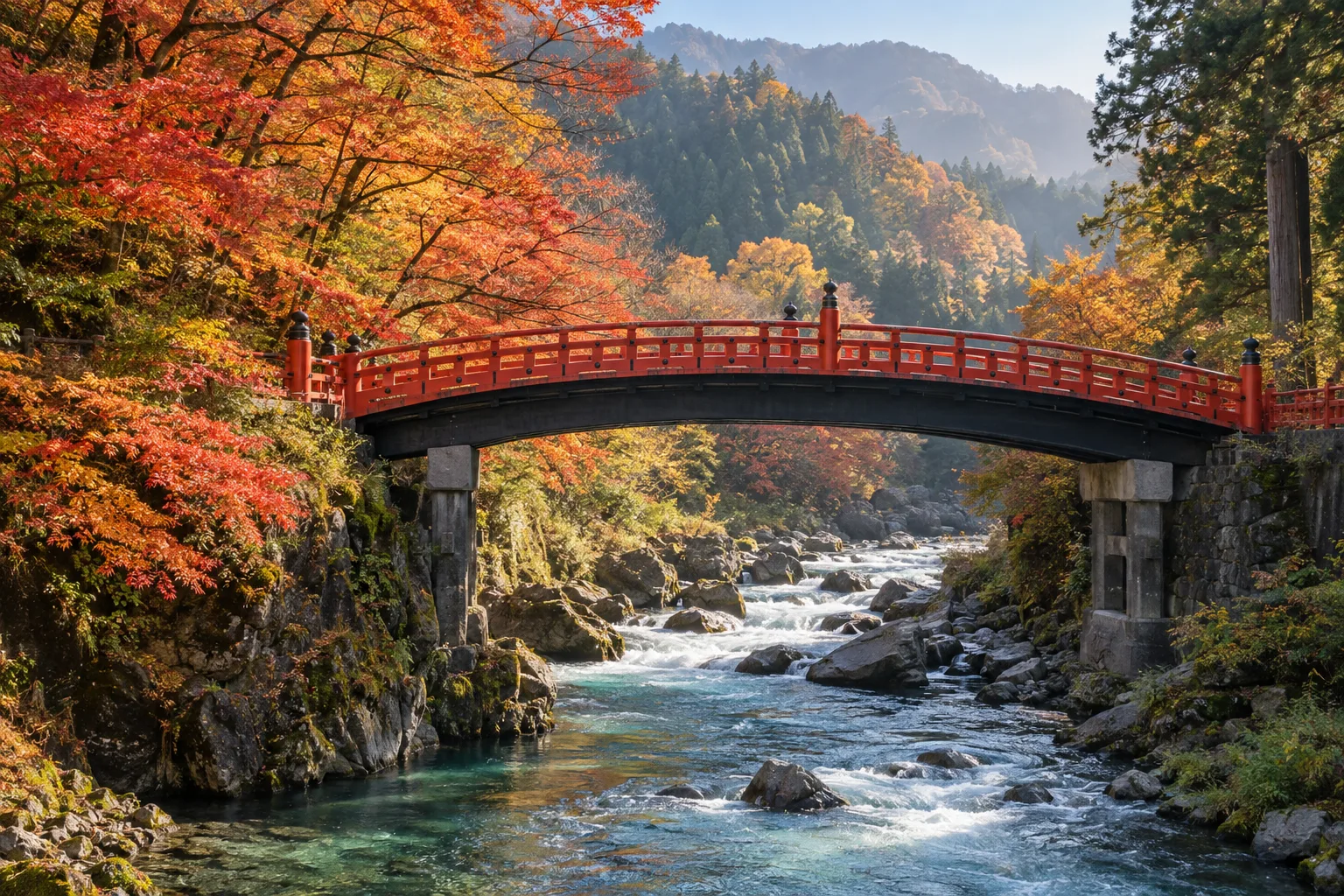
AI-generated illustration for Japan Trip Kit — not a photograph of the actual scene.
Nikko is the classic shrine-and-mountain escape from Tokyo: Toshogu’s ornate gates, the Rinno-ji temple complex, and, further up the valley, Lake Chuzenji and Kegon Falls. The confusion is rarely whether to go. It is which train to take, whether Tobu’s foreigner-only pass actually saves money, and how much you can see before the last entry times. This guide answers those three questions and lays out a realistic day.
Tobu limited express, Tobu local, or JR: which way to Nikko?
For most visitors, Tobu from Asakusa is the simplest route: one train, one operator, and a pass that covers the Nikko end. Use the JR route only if you hold a Japan Rail Pass and would rather not pay for Tobu separately. Visit Nikko, the area’s official tourism site, says limited expresses leave Shinjuku and Asakusa and take about two hours, local trains take roughly an hour longer for about half the limited-express fare, and the JR route (shinkansen to Utsunomiya, then the JR Nikko Line) costs more and needs a transfer but is fully covered by the Japan Rail Pass.
| Route to Nikko | Time | What to know |
|---|---|---|
| Tobu limited express SPACIA, Asakusa → Tobu-Nikko (direct) | About 1 hr 50 min | All seats reserved; the limited-express charge is separate from the base fare and from the pass |
| Tobu SPACIA to Shimo-Imaichi, then Tobu Nikko Line | About 1 hr 40 min + about 10 min | Two-step alternative; the Nikko Pass covers the Shimo-Imaichi–Tobu-Nikko leg |
| Tobu local trains from Asakusa | About an hour longer than the limited express | Roughly half the limited-express fare according to Visit Nikko; no seat reservation |
| JR: shinkansen to Utsunomiya, then JR Nikko Line | Not published on the pages we checked | Costs more and needs a transfer; fully covered by a Japan Rail Pass (see our JR Pass break-even guide) |
The upshot: the train ticket itself is not where the decision lies. Decide on speed and seat (limited express, about 1 hr 50 min) versus saving money (local, about an hour longer). Then decide whether to wrap the Nikko end into a pass.
Is the Nikko Pass worth it?
Buy the Nikko Pass World Heritage Area (¥3,000 adult / ¥1,500 child, two consecutive days) if you will ride the Tobu bus loop around the shrines and want your Asakusa round trip bundled; skip it if you will mostly walk or if you plan a limited-express-only trip and want to compare totals first. Tobu’s page lists it as including one round trip between Asakusa and Shimo-Imaichi, all Tobu Railway lines between Shimo-Imaichi, Tobu-Nikko and Shin-Fujiwara, and Tobu Bus lines within the World Heritage area. A limited-express ticket and any SL Taiju seat reservation are bought separately, and shrine and temple admission is not included.
- Who can buy: Tobu says the pass is only for foreign travelers; Japanese nationals accompanying them can also buy it. Carry your passport.
- Where to buy: as a digital ticket on Tobu’s Japan Trip tickets site, as a paper voucher collected at the Tourist Information Center Asakusa, or in person at that center, AC Hotel by Marriott Tokyo Ginza or Courtyard by Marriott Tokyo Ginza Tobu Hotel (in-person sales start one month before travel).
- The bigger pass: the NIKKO PASS ALL AREA is ¥8,000 adult / ¥4,000 child for four days. It adds all Tobu Bus lines in Nikko and the Lake Chuzenji cruise (seasonal). It only makes sense for a multi-day stay, not a single day trip.
- Bus-only option: a one-day World Heritage Area Bus Free Pass is ¥600 adult / ¥300 child on Tobu’s ticket site. Worth a look if you already have your own way of getting to Nikko, such as the JR route.
- Refunds: unused, still-valid passes can be refunded at any sales outlet; a cancellation fee applies.
Check the comparison yourself with Tobu’s route search: add the base fare and limited-express charge for Asakusa → Tobu-Nikko round trip, compare it with the ¥3,000 pass plus the same limited-express charges, and ask whether you will ride the Nikko buses at least a few times. If you are only going to walk Toshogu and Rinno-ji from one bus ride out and one back, a plain IC card for the buses is usually enough — see our IC card guide.
A realistic one-day plan from Tokyo
Aim for two big stops, not four: Toshogu and Rinno-ji in the middle of the day, and nothing that depends on a long bus ride up to Lake Chuzenji. Last entry is 30 minutes before closing at both sites, and closing time drops by an hour from November.
- Depart Asakusa about 8:00 a.m. on a Spacia you have reserved in advance. Tobu sells limited-express tickets from 9:00 a.m. one month before travel; online reservations are not available for the same day. Plan on arriving at Tobu-Nikko roughly 10:00 a.m.
- Late morning: ride the World Heritage Sightseeing Bus loop (Visit Nikko describes it as circling Nikko’s shrines and temples; it runs frequently from Nikko and Tobu-Nikko stations). Tobu’s own press notice names Nishisando among the stops.
- Nikko Toshogu: admission ¥1,600 for adults and high-school students, ¥550 for elementary and junior-high students (a combined ticket with the treasure house is ¥2,400 adult). Open 9:00–17:00 from April 1 to October 31, and 9:00–16:00 from November 1 to March 31; the last entry is 30 minutes before closing. The shrine’s fee page shows the Sleeping Cat corridor and the Honjido (Singing Dragon) as part of the viewing area with no separate fee. Some areas can be restricted for ceremonies or repair work.
- Rinno-ji: ¥400 adult, ¥200 for elementary and junior-high children; gates open at 8:00 and close at 17:00 (April–October) or 16:00 (November–March). Last entry is again 30 minutes before closing.
- Lunch in the shrine area or back near Tobu-Nikko Station. Pick a second-choice option before the weekend rush.
- Return to Tobu-Nikko by mid-afternoon and book a limited express back that leaves you a buffer, not the last possible train. Sort out bags before you go — see luggage forwarding if you are changing hotels that night.
Rough day budget per adult (pass route, two sights): ¥3,000 pass + ¥1,600 Toshogu + ¥400 Rinno-ji = ¥5,000, plus the limited-express charge (check Tobu’s route search), lunch and snacks. Add the Toshogu treasure-house combination only if you have time left; it raises the Toshogu ticket to ¥2,400.
What to skip if you are short on time
If you only have one day, do Toshogu and Rinno-ji and leave Lake Chuzenji and Kegon Falls for another trip. Visit Nikko warns that in peak foliage season (mid-October to mid-November) travel from Nikko Station to Lake Chuzenji can stretch from the usual 45 minutes to more than four hours.
- Skip Lake Chuzenji on a single autumn day trip; the traffic risk alone can wipe out the afternoon.
- Skip the ALL AREA pass (¥8,000) unless you are staying more than one night.
- Skip a late start. Arrive after noon and you hit last entry times and rush-hour trains back.
- Skip packing in every temple. The passes exclude admission fees, so each extra site adds cost and walking time.
Day trip or overnight?
A day trip is enough for Toshogu and Rinno-ji. Stay overnight if you want Lake Chuzenji, Kegon Falls, the onsen area, or a calm morning before day-trippers arrive. Nikko to Kinugawa Onsen takes 35 to 45 minutes by train from Tobu-Nikko Station, so a longer trip can combine the shrines with a hot-spring night.
Frequently asked questions
Is Nikko worth a day trip from Tokyo?
Yes, if you want shrines and temples with a mountain backdrop about two hours from central Tokyo. It is a full day: you will spend roughly four hours on trains, so start early.
Can I use the Nikko Pass with a Japan Rail Pass?
They are separate products. The Nikko Pass is a Tobu Railway product for foreign travelers and covers Tobu lines and Tobu buses. A Japan Rail Pass covers the JR route via Utsunomiya. Do not buy both for the same trip.
Do I need to reserve a limited express seat?
For Spacia, yes: Tobu states all seats are reserved. Limited-express tickets go on sale at 9:00 a.m. one month before the travel date. Local trains need no reservation.
Does the pass include shrine admission?
No. Tobu’s page states that admission fees for shrines and temples in Nikko, Tobu World Square and EDO WONDERLAND Nikko Edomura are not included.
What time should I leave Tokyo?
Around 8:00 a.m. from Asakusa. That puts you at the shrines by late morning, with time before the 5:00 p.m. closings (4:00 p.m. from November) and the 30-minute last-entry cutoff.
How we checked: official sources
- Tobu Railway: Nikko Pass World Heritage Area (¥3,000 / ¥1,500, two days, coverage, exclusions) and NIKKO PASS ALL AREA (¥8,000 / ¥4,000, four days)
- Tobu Japan Trip tickets: Nikko passes and bus free passes (World Heritage Area Bus Free Pass ¥600 / ¥300)
- Tobu Railway: access to Nikko (Spacia, about 1 hr 50 min direct), Limited Express SPACIA (all seats reserved) and how to purchase limited express tickets
- Visit Nikko: getting to and around Nikko (local vs limited express, JR route, World Heritage bus, peak-season Lake Chuzenji delays)
- Nikko Toshogu: admission and viewing hours (Japanese page)
- Rinno-ji: admission and hours
- Tobu Railway press release: April 2025 Nikko Pass price revision (World Heritage bus stops)
All checked October 22, 2026. Fares, passes and timetables can change, so confirm the price and the train on the operator’s site before you travel.
Editorial information
- Written by
- Mahalohana
- Published
- Updated
- Last verified