
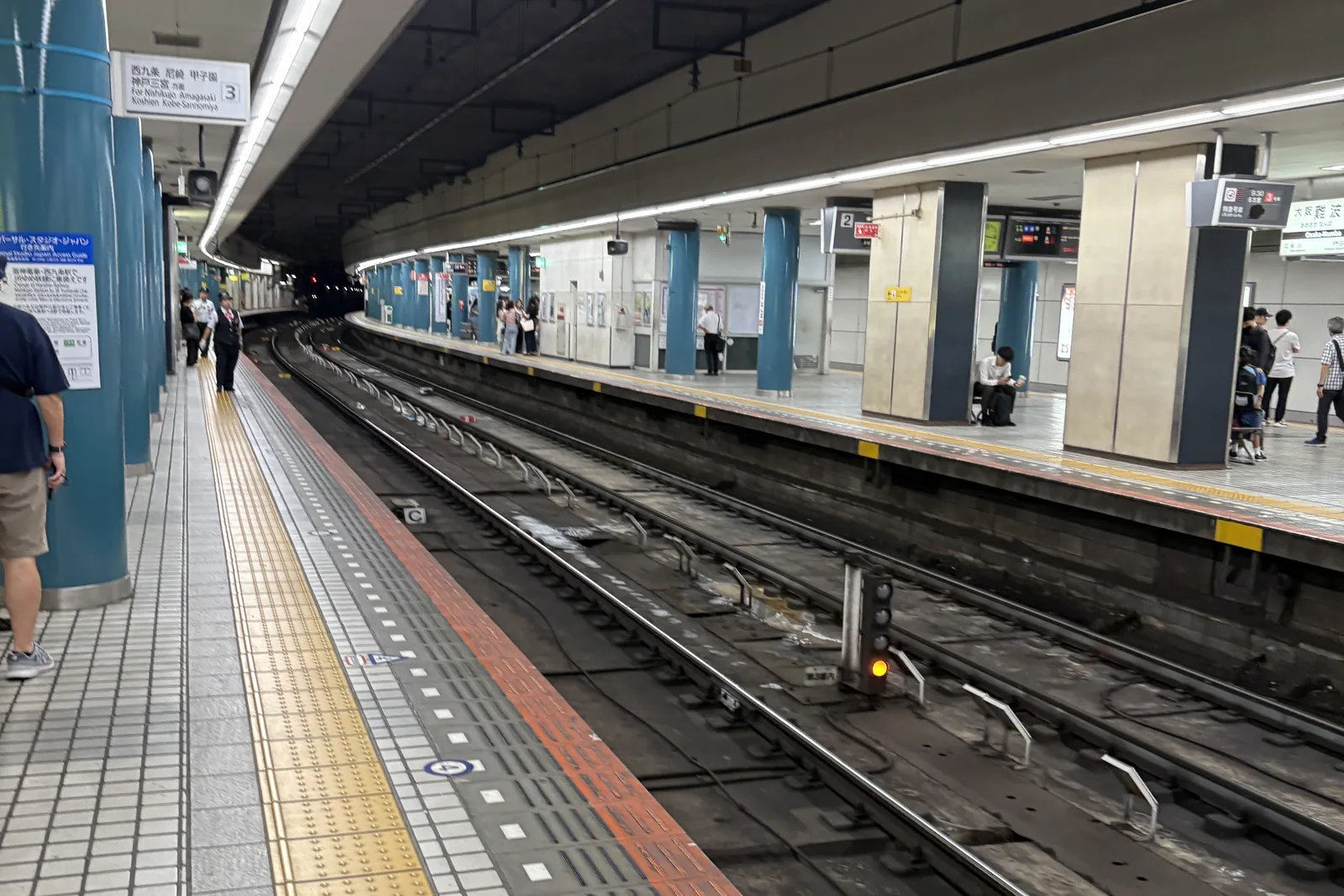
Photo: Mahalohana / Japan Trip Kit
ICOCA is JR-West’s rechargeable IC card, the Kansai counterpart of Tokyo’s Suica. You touch it on the gate reader when you enter and when you leave, and the fare comes off the balance. JR-West says it also works as electronic money in shops showing the ICOCA mark, and on railways and buses in the other IC-card areas, Suica’s and PASMO’s included. The real choice is the form you carry it in, and how much of your money you can get back on the last day. Where it fits in an Osaka trip is laid out in our Osaka, Kyoto and Kansai hub.
Which ICOCA, or which other way to pay, fits your trip?
Start from the phone you carry and who is travelling with you, then read across. Each row names the product, what it costs to get, and the rule most likely to catch you out.
| Your situation | Use this | Cost and the catch |
|---|---|---|
| iPhone 8 or later (iOS 16 or later) with a Visa, Mastercard, JCB or American Express card in Apple Wallet | ICOCA in Apple Wallet | No card to buy and no deposit; you top up with your card at any time. The balance cannot be refunded through Apple Wallet, so add small amounts. |
| Android phone, or no phone wallet | Card ICOCA from an ICOCA-mark ticket machine or a JR ticket office | ¥2,000, of which ¥500 is a deposit; cash only, no credit cards. On the way out, the refund is your balance minus a ¥220 fee, plus the ¥500 deposit (deposit only if the balance is ¥220 or less). |
| Landing at Kansai Airport with a foreign passport, entering as a Temporary Visitor, and you want the special design | Original-design visitor ICOCA (Wind and Thunder Gods) | ¥2,000 including the ¥500 deposit, one per person, sold only at the JR Ticket Office at Kansai-airport Station |
| You already hold a Suica or PASMO from Tokyo | Keep using it | Nothing to buy: JR-West lists Suica and PASMO among the IC cards accepted on railways and buses in the ICOCA area, and PASMO confirms the same from its side |
| Adults riding mostly the Osaka Metro, with a contactless bank card | Tap the bank card at the gate | Adult fare per ride, ¥190 to ¥390 by distance. Nankai takes card taps only at dedicated gates in some stations, so check before relying on it. |
| Travelling with children | A child’s ICOCA from a JR-West ticket office, or the child’s own IC card | Card taps on Osaka Metro and Nankai charge children the adult fare. The child ICOCA needs an official ID (a passport works) at the counter. |
If two rows fit, the phone row wins for adults on a short trip: no deposit means no last-day refund queue. Children are the exception. On Osaka Metro, a 3 to 7 km ride costs a child ¥120 against ¥240 for an adult, so a family that taps bank cards pays double for every child.
Where do you buy a card ICOCA at Kansai Airport or in Osaka?
At any JR-West ticket machine showing the ICOCA mark, or at a JR ticket office (Midori-no-madoguchi). The standard card is sold at ICOCA-area stations, and some ticket machines also sell it for ¥1,000, ¥3,000, ¥5,000 or ¥10,000, each including the ¥500 deposit. Bring yen: the card cannot be bought with a credit card. Some other railways sell ICOCA too, but JR-West’s station machines are the most dependable option for adults.
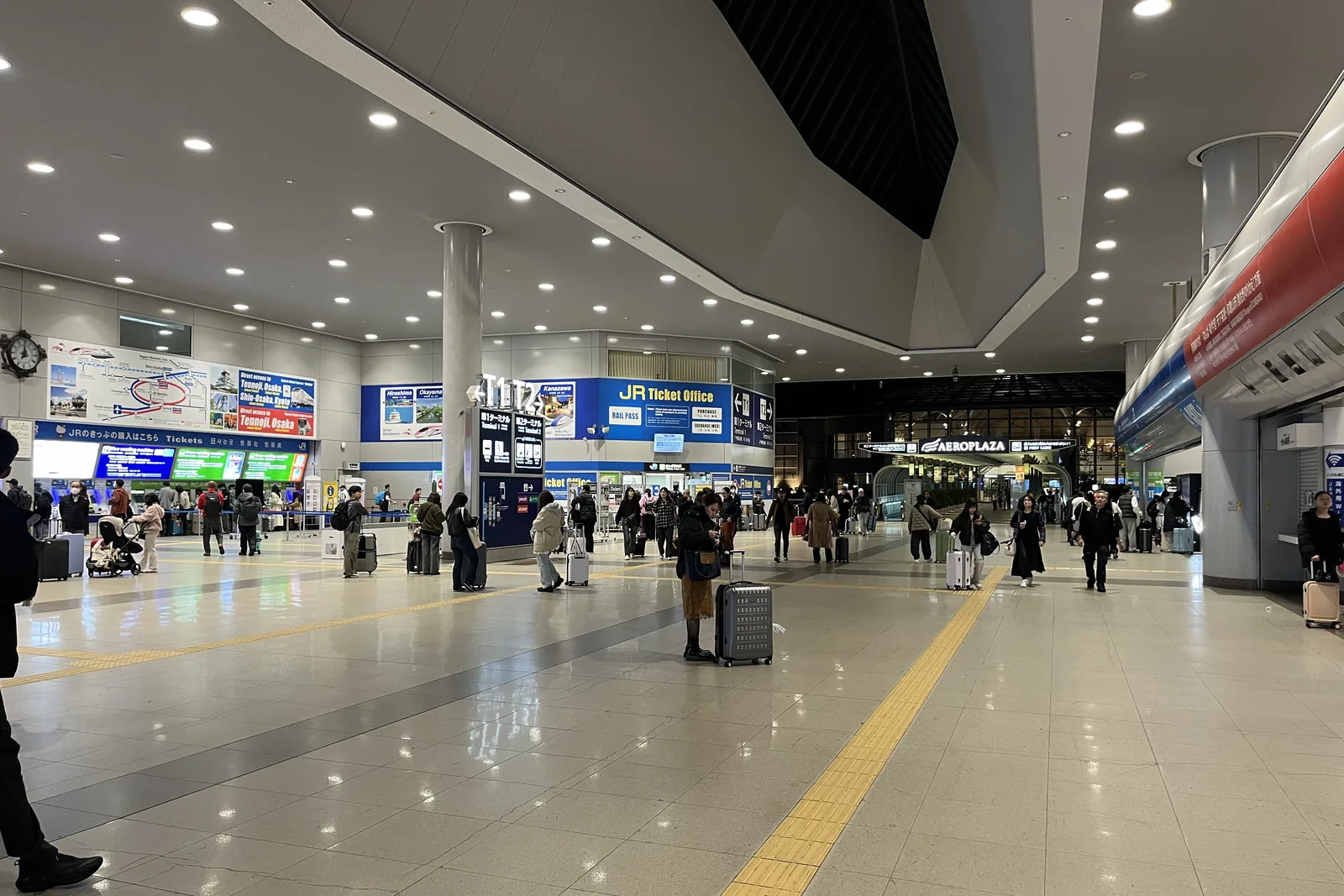
Photo: Mahalohana / Japan Trip Kit
The visitor design is a separate product. JR-West sells the Wind and Thunder Gods ICOCA only at the JR Ticket Office at Kansai-airport Station, one per person, to holders of a non-Japanese passport who are in Japan as a Temporary Visitor. Japanese nationals cannot buy it, even with permanent residence abroad. It costs the same ¥2,000 as the standard card and works the same way, so queue for it only if you want the design. Our Kansai Airport to Osaka guide shows which trains leave from that station.
Top-ups work the same way for both cards: put cash into a ticket machine, a fare adjustment machine or a charge machine with the ICOCA mark, or ask at a participating shop. A card cannot hold more than ¥20,000.
Can a visitor add ICOCA to an iPhone or Android phone?
On an iPhone, usually yes; on an Android phone from outside Japan, plan on the plastic card. JR-West’s Apple Pay page lists four conditions: an iPhone 8 or later on iOS 16 or later (or an Apple Watch Series 3 or later), a signed-in Apple Account, a device region that supports Apple Pay, and a card from a country or region that supports Apple Pay. Funds can only be added from credit cards carrying the Visa, Mastercard, JCB or American Express logo, and JR-West warns that some cards are not supported.
- Set it as the Express Transit card. Then the phone opens the gate without being unlocked.
- Moving a plastic ICOCA into Wallet is possible. JR-West says the remaining funds and other details carry over.
- Leftover money stays in the phone. Apple Wallet cannot refund it. JR-West’s refund page adds that the phone version never took a deposit: when you move a plastic card in, the deposit becomes balance.
- Android: Mobile ICOCA runs only on phones with Android 10 or later and the Osaifu-Keitai app, a Japanese mobile-wallet feature. JR-West publishes a list of compatible models; if yours is not on it, buy the card.
Worked example: four days in Osaka on one card ICOCA (December 3 to 6, 2026)
Picture an adult who buys a plastic ICOCA on landing, stays in Namba and flies home from Kansai Airport. The fares are the ones the operators publish for these dates; on Nankai and Osaka Metro an ICOCA pays the regular fare for the section, so ¥970 is what the card is charged. For the six subway rides, assume each is a 3 to 7 km trip (Osaka Metro’s Section 2).
| Step | Fare or top-up | Balance after |
|---|---|---|
| Dec 3: buy the card at Kansai-airport Station (¥2,000 cash) | ¥500 held as deposit | ¥1,500 |
| Dec 3: Nankai Airport Express, Kansai Airport to Namba (about 46 minutes) | −¥970 | ¥530 |
| Top up at a ticket machine | +¥1,000 | ¥1,530 |
| Dec 4 and 5: six Osaka Metro rides of 3 to 7 km | −¥1,440 (6 × ¥240) | ¥90 |
| Top up | +¥1,000 | ¥1,090 |
| Dec 6: Nankai Airport Express, Namba to Kansai Airport (about 45 minutes) | −¥970 | ¥120 |
| Dec 6: refund at a JR-West machine or ticket office at Kansai-airport Station | ¥120 is below the ¥220 fee | ¥500 back (deposit only) |
The rides cost ¥3,380. The traveller put in ¥4,000 and took ¥500 back, so ¥120 of balance was lost to the refund fee. Two habits keep that loss small:
- Top up in ¥1,000 steps near the end. Had the last top-up been ¥2,000, ¥1,120 would be left on the card and the refund would be ¥1,400 (¥1,120 − ¥220 + ¥500): the full ¥220 fee gone. Small top-ups keep the leftover small, so it is easier to spend before you refund.
- Spend a small balance before you refund. Any balance at or below ¥220 brings back only the ¥500 deposit, so a ¥120 balance is worth more in an airport vending machine than at the refund counter.
The same four days on an iPhone ICOCA cost ¥3,380 in fares, with nothing paid up front. Whatever is left at the end stays on the phone, so keep the last top-up small. Paying with a bank card at the Osaka Metro gates would cost the same ¥1,440 for those six rides, since card taps charge the regular adult fare.
How do you get the ¥500 deposit back before you fly?
Hand the card in at a JR-West station in the ICOCA area: a JR ticket office or a ticket machine that handles refunds, such as the pink ticket machines. JR-West’s refund page gives the formula as card balance minus the ¥220 refund fee, plus the ¥500 deposit. If the balance is ¥220 or less, you get the ¥500 deposit only.
- Pink ticket machines refund unregistered ICOCA cards, but not when the refund would be ¥10,000 or more; use the ticket office for those.
- No refunds between 0:50 and 5:00, whatever the station’s hours. That matters if you plan to refund the card before catching a first train to the airport.
- Use a JR-West station. JR-West handles card refunds at its own stations in the ICOCA area, so go to the JR side, not the Nankai side, at Kansai Airport.
- Phone versions (Mobile ICOCA and ICOCA in Apple Wallet) are not refunded at stations or through Apple Wallet. The refund is done in the ICOCA app or on JR-West’s member website, outside the ticket gates: the balance minus the ¥220 fee goes to a bank account you enter (bank, branch and account number), about 2 to 6 weeks later, and nothing comes back if the balance is below the fee. For a short trip, spending it down is simpler.
You can also keep the card. The ¥500 deposit stays on it, and the balance is ready for the next trip.
Where does ICOCA stop working?
On the Shinkansen, on limited expresses such as Haruka unless you also buy a limited express ticket, and on trips that cross from one IC-card area into another. JR-West’s usage-area page says ICOCA cannot be used on Shinkansen trains and, with some exceptions, cannot cover a single trip between two different IC-card areas. Inside the ICOCA area it cannot cover trips of more than 200 km of service distance, except within the Osaka suburban area and on a few listed limited express routes. For a Kyoto, Nara or Kobe day trip from Osaka on local or rapid trains, those limits do not come into play.
- One card per trip. You cannot combine two ICOCA cards, and you must leave with the card you entered on.
- Haruka needs a ticket. JR-West’s Apple Pay page uses Haruka as its example of a limited express that needs a separate limited express ticket. Fares and the visitor ticket are compared in our Kansai Airport to Kyoto guide.
- Shops that take only PiTaPa do not take ICOCA. JR-West notes that ICOCA electronic money is not accepted where only PiTaPa is taken; the gates of PiTaPa railways such as Hankyu, Keihan, Kintetsu, Nankai and Osaka Metro do accept ICOCA for fares.
Do you still need ICOCA if your bank card can tap?
For adults who ride mostly the subway, not really; for JR trains, mixed railway days and children, an IC card is simpler. Osaka Metro says contactless Visa, Mastercard, JCB, American Express, Diners Club, Discover and UnionPay cards, or a phone carrying one, work at the dedicated reader on its ticket gates with no registration, at regular adult fares. Nankai offers card taps on dedicated gates at some entrances of some stations, again at adult fares. ICOCA covers every ride in the worked example, with no need to look for a card-tap gate.
A bank card tap also leaves no balance behind, which suits a two-day stay. The trade-offs are the adult fare for children and checking which gate takes cards. If you are deciding between Namba and Umeda as a base, our Namba or Umeda guide shows which railways start from each. Arriving from Tokyo with a Suica already in hand? Our Suica guide covers that card.
Quick questions about ICOCA in Osaka and Kyoto
Is ICOCA the same as Suica?
They are different companies’ cards, but JR-West lists Suica among the cards that work on railways and buses in the ICOCA area, and ICOCA works in Suica’s area. You do not need both.
Can I buy ICOCA with a credit card?
Not the plastic card: JR-West’s purchase page says it cannot be bought with a credit card. ICOCA in Apple Wallet is topped up from a Visa, Mastercard, JCB or American Express card.
Can I pay at convenience stores with ICOCA?
Yes, at shops showing the ICOCA mark and at shops that take Suica, PASMO and the other nationwide IC cards (but not shops that take only PiTaPa). If the balance falls short at a shop, you pay the rest in cash, and only one ICOCA can be used per payment.
When does a child ICOCA stop working?
On March 31 at the end of the Japanese school year (April to March) in which the child turns 12. After that date the child ICOCA can be refunded without the ¥220 fee; a child ICOCA refund needs an official ID such as the child’s passport.
Can I use ICOCA for the Shinkansen to Tokyo?
No. JR-West says ICOCA cannot be used on Shinkansen trains; buy a Shinkansen ticket.
Can two people share one ICOCA?
Not on the same trip. One card covers one person through the gate, and you must exit with the card you entered on.
How we checked: official sources
- JR-West: ICOCA guide for visitors (original-design ICOCA for foreign visitors, ¥2,000 incl. ¥500 deposit, Kansai-airport Station)
- JR-West: ICOCA on Apple Pay (device and card requirements, no refund through Apple Wallet)
- JR-West: ICOCA usage area (other IC cards, Shinkansen, 200 km rule)
- JR-West: ICOCA electronic money and top-ups (¥20,000 balance cap)
- JR-West: How to buy ICOCA (price, deposit, cash only, child ICOCA; Japanese)
- JR-West: ICOCA refunds (¥220 fee, where and when; Japanese)
- JR-West: ICOCA usage area and mutual use (regular fare on PiTaPa-area railways; Japanese)
- JR-West: Refunding ICOCA on Apple Pay (app or member site, ¥220 fee, bank transfer in 2 to 6 weeks; Japanese)
- PASMO: Usage area and mutual use with ICOCA and other IC cards (Japanese)
- JR-West: Mobile ICOCA for Android, compatible phones (Japanese)
- Osaka Metro: Fares (adult and child fares by section)
- Osaka Metro: Contactless payment (card brands, adult fares only)
- Nankai: Touch payment (select stations, adult fares only)
- Nankai: route search, Kansai Airport to Namba, December 3, 2026 (Airport Express ¥970; Japanese)
- Nankai: route search, Namba to Kansai Airport, December 6, 2026 (Airport Express ¥970; Japanese)
All checked November 17, 2026. Fares and card rules can change; confirm on the operator page before you pay.
Editorial information
- Written by
- Mahalohana
- Published
- Last verified
Sources
- JR-West: ICOCA guide for visitors (original-design ICOCA for foreign visitors, ¥2,000 incl. ¥500 deposit, Kansai-airport Station) — www.westjr.co.jp
- JR-West: ICOCA on Apple Pay (device and card requirements, no refund through Apple Wallet) — www.westjr.co.jp
- JR-West: ICOCA usage area (other IC cards, Shinkansen, 200 km rule) — www.westjr.co.jp
- JR-West: ICOCA electronic money and top-ups (¥20,000 balance cap) — www.westjr.co.jp
- JR-West: How to buy ICOCA (price, deposit, cash only, child ICOCA; Japanese) — www.jr-odekake.net
- JR-West: ICOCA refunds (¥220 fee, where and when; Japanese) — www.jr-odekake.net
- JR-West: ICOCA usage area and mutual use (regular fare on PiTaPa-area railways; Japanese) — www.jr-odekake.net
- JR-West: Refunding ICOCA on Apple Pay (app or member site, ¥220 fee, bank transfer in 2 to 6 weeks; Japanese) — www.jr-odekake.net
- PASMO: Usage area and mutual use with ICOCA and other IC cards (Japanese) — www.pasmo.co.jp
- JR-West: Mobile ICOCA for Android, compatible phones (Japanese) — www.jr-odekake.net
- Osaka Metro: Fares (adult and child fares by section) — subway.osakametro.co.jp
- Osaka Metro: Contactless payment (card brands, adult fares only) — subway.osakametro.co.jp
- Nankai: Touch payment (select stations, adult fares only) — www.nankai.co.jp
- Nankai: route search, Kansai Airport to Namba, December 3, 2026 (Airport Express ¥970; Japanese) — kensaku.nankai.co.jp
- Nankai: route search, Namba to Kansai Airport, December 6, 2026 (Airport Express ¥970; Japanese) — kensaku.nankai.co.jp