
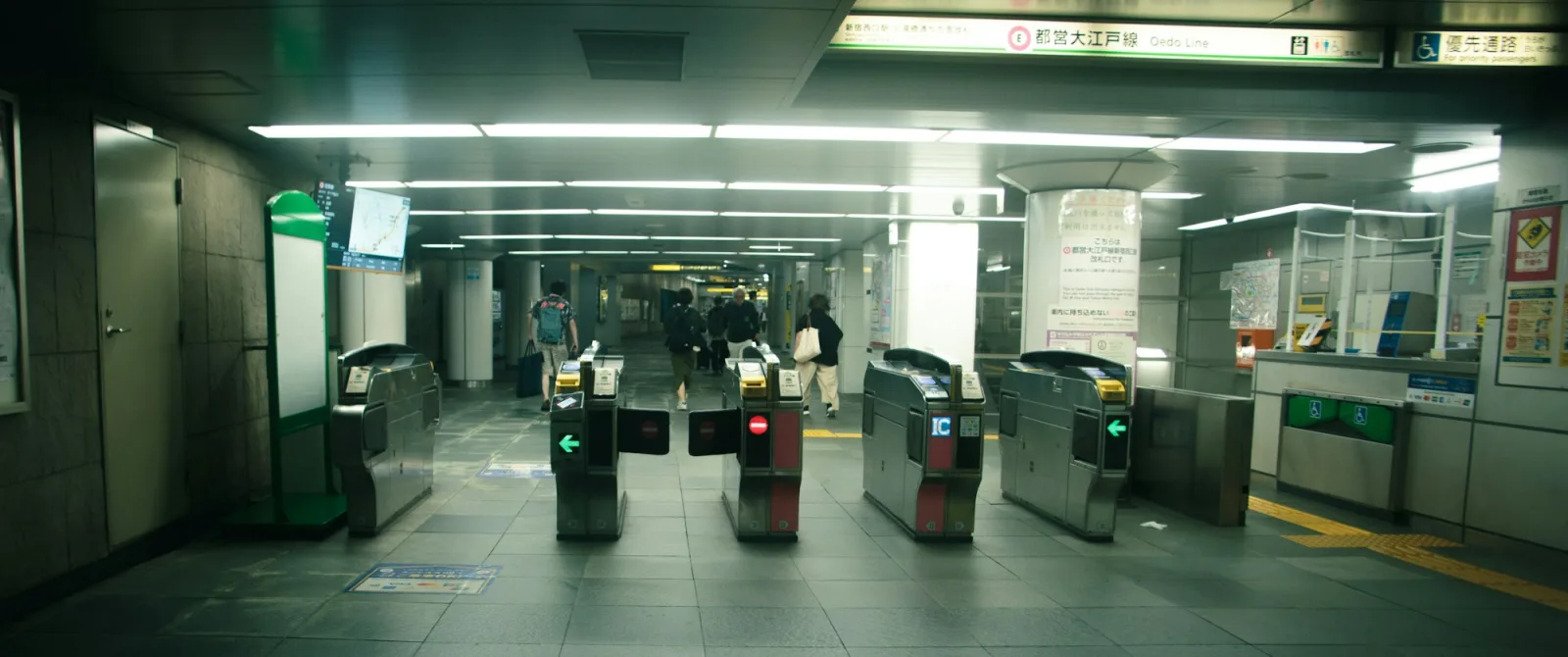
Photo: Thiago Yonamine / Unsplash
If you have read a Suica guide from before 2025, parts of it are out of date. JR East now sells a visitor-only card, the Welcome Suica, and in March 2025 it launched an iPhone app for visitors. The details that matter for planning are small but easy to get wrong: how many days the card lasts, whether you get anything back, where you can buy it, and how far it works from Tokyo. The one that catches many first-timers: the card does not follow you from Tokyo to Osaka by train.
Welcome Suica, Suica or the iPhone app: which one?
If you are staying under 28 days and want the least friction, the Welcome Suica card is the default; if you have an iPhone and want to skip the counter, the app is the modern alternative. The regular Suica is the odd one out for visitors because it needs a deposit, and getting that back means a visit to a JR East station.
| Option | Cost and deposit | How long it lasts | Refund |
|---|---|---|---|
| Welcome Suica card | Pick a starting balance of ¥1,000, ¥2,000, ¥3,000, ¥4,000, ¥5,000 or ¥10,000; no deposit | 28 days, counting the day you buy it | None, even with money left |
| Welcome Suica Mobile (iPhone app) | You issue the Suica in the app and add value there; JR East’s page lists no deposit | 180 days from issue | None; the balance expires with the validity period |
| Regular Suica card | Same ¥1,000 to ¥10,000 price points, with a ¥500 deposit included | Unused for 10 years before it lapses | Deposit and balance back at JR East stations, minus a ¥220 fee |
The practical gap is the refund. The regular Suica gives your deposit back, but JR East’s own example shows what a refund looks like: a ¥1,000 balance returns ¥1,280 after the ¥220 fee and the ¥500 deposit. With a balance of ¥100 or ¥0 you still get the ¥500 back. That is only worth the trip if you are already at a JR East station on your last day. For most visitors, a card with no deposit and no refund is simpler, provided you do not load more than you expect to spend.
Where to buy the card, and what to ask for
Buy at the airport so the card works the moment you reach the gates: Narita Terminal 1 or 2/3, or Haneda Terminal 3. JR East says that since March 27, 2025, the Welcome Suica has been sold at JR East Travel Service Centers and at dedicated Welcome Suica ticket vending machines, and that in principle only one card is sold to each person.
- Vending machines: Narita Airport Terminal 1 Station, Narita Airport Terminal 2/3 Station and Haneda Airport Terminal 3 (Tokyo Monorail) Station.
- Travel Service Centers: the same three airport stations, plus Tokyo, Shibuya, Shinjuku, Ikebukuro, Ueno, Yokohama and Sendai stations.
- Also listed: JAPAN RAIL CAFÉ TOKYO and the TAKANAWA GATEWAY Travel Service Center.
- Children: the child card is valid until March 31 after the child’s 12th birthday. JR East asks for the child’s ID (a passport, for example), and a family member can buy it. If an older child uses a child card, the adult fare plus a penalty of twice the fare applies.
- The reference paper: the machine gives you a slip with the card’s validity period and balance. The expiry is not printed on the card, and the GOOD THRU date on the back is not the end of the 28 days, so keep the slip.
If you land at Haneda, the card is also valid on the Tokyo Monorail that JR East lists as covered, so you can buy at the monorail terminal and tap straight through; our Haneda to Tokyo guide compares the ways into the city.
How the 28-day clock and the top-up rules work
The 28 days start on the day you buy the card, not on the day you first ride, so buy it on arrival, not at home or a week into the trip. JR East counts the purchase date as day one and the card stops working on the 29th day.
Topping up is cash-only. JR East says the Welcome Suica can be topped up as often as you like during its validity, up to a maximum balance of ¥20,000, at ticket vending and fare adjustment machines that show the Welcome Suica mark, and at Seven Bank ATMs, which are in 7-Eleven stores and other convenience stores. You cannot top up the card with a credit card; top-ups are cash (yen) only. That is why a little cash still matters even in a card-friendly country; our cash or card guide covers where else you will need it.
The sensible habit is to start with a modest balance (¥2,000 to ¥3,000 covers a few days of Tokyo rides), then top up at a station machine when it runs low. Because there is no refund, a ¥10,000 starting balance on a four-day trip is money you will probably not spend. The card is not a ticket for everything either: JR East says limited express and express trains and Green Cars need a separate ticket bought in advance.
What the card works on, and where it stops
It covers the Tokyo area’s trains, subways, buses and the Tokyo Monorail, and it pays in shops, but it does not link areas together. JR East lists the Tokyo metropolitan area plus the Sendai, Niigata, Aomori, Morioka and Akita areas and parts of the Hokkaido, Tokai, West Japan and Kyushu areas.
The rule that catches people is that a journey must start and end in the same area. JR East’s example is that you cannot use the card to travel from the Tokyo area to the Sendai area. When you cross from one area to another, JR East says to leave the ticket gate first and then re-enter. A long ride such as the Shinkansen to Osaka or Kyoto is not something to tap through on this card; buy a ticket for it separately.
- Shopping: JR East lists purchases on trains, vending machines, coin lockers, convenience stores and restaurants.
- Mutual-use network: the card works wherever the nationwide mutual-use logo appears, including Kitaca, PASMO, manaca, TOICA, ICOCA, Hayakaken, nimoca and SUGOCA. JR East says it cannot be used at stores in PiTaPa areas.
- Passes: some passes can be registered onto a Welcome Suica: the NONBIRI Holiday Suica Pass, the Tokyo Metropolitan District Pass (Tokunai Pass), the Yokohama-Minatomirai Pass and the Tokyo 1-Day Ticket. If you buy a pass at the same time, you pay for it then.
iPhone and Android: what the app really does
Welcome Suica Mobile is for iPhone: JR East says it works only on devices that support Apple Pay, for ages 13 and up, and the Suica it issues lasts 180 days. According to JR East’s page, the app issues the Suica, lets you top up, and also sells Green Car tickets on local trains and reserved seats on the Shinkansen and the Narita Express through JR-EAST Train Reservation.
Two details to plan around. First, JR East warns that app download and top-up features are restricted by law in some countries, and that you may have to set up and add value only after arriving in Japan; download the app before you go, turn on location services (it uses location to decide whether value can be added), and test the issue step in Japan, not on the flight. Second, the remaining balance is not refunded and expires at the end of the 180 days. JR East’s page was current as of March 2026.
For Android phones, JR East’s visitor page names only the Apple Pay route. The simple Android answer is to buy the physical Welcome Suica card at the airport. If JR East adds an Android version, its Welcome Suica Mobile page will say so.
Osaka, Kyoto and the rest of the trip
Suica is JR East’s IC card; in Kansai, the local equivalent is ICOCA, but you rarely need to buy a second card. JR East lists the ICOCA logo among the mutual-use cards, and JR West says ICOCA works on railways and buses across Japan. Because JR East lists parts of West Japan as covered, a Welcome Suica should work on local trains and buses there, but check JR East’s area map for your line before relying on it. The 28 days are fixed, so a long trip that starts in Tokyo and ends in Osaka may outlast one card.
If you want a Kansai card, JR West says an original-design ICOCA for foreign visitors is available. Requirements: a passport issued by a government other than Japan, and temporary visitor status. It costs ¥2,000, including a ¥500 deposit, is limited to one per person, and is sold at the JR ticket office (Midori-no-madoguchi) at Kansai Airport Station. JR West also says ICOCA on Apple Pay works on iPhone.
For longer stays, JR East lists a Welcome Suica (long-term use) valid for up to six months, but it is sold only in bulk to travel agents, not at Travel Service Centers. If you are staying that long, ask your travel agent, or plan to buy a second 28-day card.
A five-minute checklist before you fly
Decide in advance: card or app, how long, and how much cash to carry. Work through these in order.
- Count the days from purchase to your last planned use. Up to 28 days, counting the purchase day: a Welcome Suica card is fine. Over 28 days: plan a second card, or use the app, which lasts 180 days.
- iPhone owner? Download Welcome Suica Mobile at home and read the setup steps; if the issue step is blocked from your country, do it on arrival.
- Plan the first top-up. Start with ¥2,000 to ¥3,000 and keep ¥5,000 of cash in your wallet for the machines.
- Buy on arrival. The clock starts on the day you buy, so do it at the airport machine, then go straight to the gates.
- Keep the slip. The reference paper shows the expiry; the card does not.
- Leaving Tokyo for Kansai? Buy the Shinkansen ticket separately; the Suica is not a ticket for that stretch.
Our earlier IC card guide compares Suica with PASMO and subway passes.
Exceptions: when a Suica is the wrong tool
Skip the card on a trip that is mostly one pass or mostly Shinkansen. If you have a JR rail pass for the days that matter, you will not tap an IC card for those rides.
- Staying in one other region (Hokkaido, Kyushu): check that the local operator accepts the Suica logo before you load a large balance.
- Travelling with children: the child card is a separate product with ID rules; at a Welcome Suica machine you enter the child’s birth date.
- Taking only the Narita Express: the Welcome Suica does not replace the ticket for limited express trains.
What wastes money when you buy a Suica?
Worked example, four days in Tokyo: you start with ¥3,000, run low midweek and top up at a station machine with the Welcome Suica mark; the ¥20,000 balance cap leaves plenty of room. Had you loaded ¥10,000 at the start, whatever was left at the airport would be non-refundable.
- Skip loading more than you will spend. The balance cap is ¥20,000, and unused money cannot be returned.
- Skip buying the regular Suica just for the deposit. Between the refund trip and the ¥220 fee, the Welcome Suica is usually simpler.
Frequently asked questions
How much does the Welcome Suica cost?
There is no deposit; you choose a starting balance of ¥1,000, ¥2,000, ¥3,000, ¥4,000, ¥5,000 or ¥10,000 and that is the money you can spend.
How long is the Welcome Suica valid?
28 days, counting the day of purchase. JR East says the card becomes invalid on the 29th day, and the GOOD THRU date printed on the card is not the expiry.
Can I use Suica on Android?
JR East’s visitor app works only on devices that support Apple Pay. If you carry an Android phone, buy the physical Welcome Suica card.
Can I get a refund on a Welcome Suica?
No. JR East says no refunds are available regardless of the remaining balance or validity. Only the regular Suica returns its deposit and balance, minus a ¥220 handling fee.
Does a Welcome Suica work in Osaka?
JR East lists parts of West Japan among its covered areas and shows the ICOCA logo among the mutual-use cards. A journey has to start and end in one area, so you cannot ride from Tokyo to Osaka on it.
How we checked: official sources
- JR East: What is a Suica? (card types, 28 days, ¥500 deposit)
- JR East: Welcome Suica (areas covered, mutual use, passes, long-term card)
- JR East: Welcome Suica purchasing and using (price points, sales locations, validity, top-up, refunds)
- JR East: Welcome Suica Mobile (iPhone app, 180 days, Apple Pay, Green Car)
- JR East: Suica (price, deposit, refund and ¥220 handling fee, 10-year validity)
- JR East: Welcome Suica (long-term use)
- JR West: ICOCA (visitor design card, ¥2,000, Kansai Airport)
All checked October 25, 2026. Fares, prices and timetables can change; confirm on the operator page before you pay.
Editorial information
- Written by
- Mahalohana
- Published
- Updated
- Last verified
Sources
- JR East: What is a Suica? — JR East
- JR East: Welcome Suica — JR East
- JR East: Welcome Suica purchasing and using — JR East
- JR East: Welcome Suica Mobile — JR East
- JR East: Suica — JR East
- JR East: Welcome Suica (long-term use) — JR East
- JR West: ICOCA — JR West